3D maps of the Magellanic Clouds using Classical Cepheids
This paper uses classical Cepheids to create detailed 3D maps of the Magellanic Clouds, employing mid-infrared data for improved distance measurements. The study combines OGLE-IV catalogue data with Spitzer photometry to achieve unprecedented mapping fidelity.
Abstract
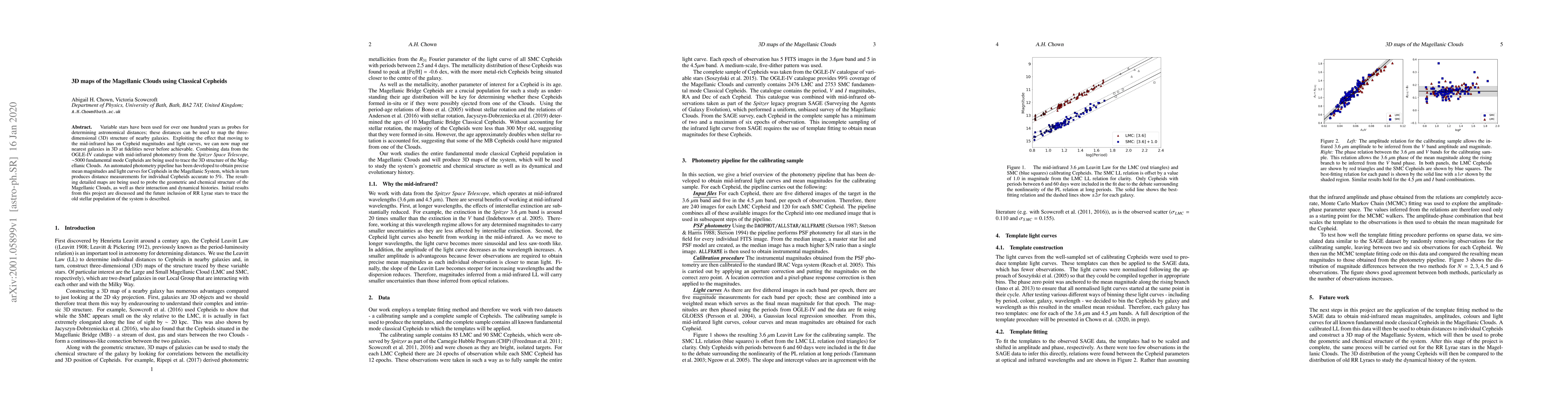
Variable stars have been used for over one hundred years as probes for determining astronomical distances; these distances can be used to map the three-dimensional (3D) structure of nearby galaxies. Exploiting the effect that moving to the mid-infrared has on Cepheid magnitudes and light curves, we can now map our nearest galaxies in 3D at fidelities never before achievable. Combining data from the OGLE-IV catalogue with mid-infrared photometry from the Spitzer Space Telescope, around 5000 fundamental mode Cepheids are being used to trace the 3D structure of the Magellanic Clouds. An automated photometry pipeline has been developed to obtain precise mean magnitudes and light curves for Cepheids in the Magellanic System, which in turn produces distance measurements for individual Cepheids accurate to 5%. The resulting detailed maps are being used to probe the geometric and chemical structure of the Magellanic Clouds, as well as their interaction and dynamical histories. Initial results from this project are discussed and the future inclusion of RR Lyrae stars to trace the old stellar population of the system is described.
AI Key Findings
Get AI-generated insights about this paper's methodology, results, significance, and more — available when analysis has been generated.
Discussion 0