A Bag of Tricks for Defending Deep Learning-based Face Recognition Pipelines against Backdoor Attacks
Abstract
The protection of mature, multi-stage Face Recognition Systems is crucial to system providers. This technical report targets the threat model most relevant to industry practitioners: although model training is performed in-house, training data is sourced from possibly-compromised third parties. Given this setting, we present three practical defense "tricks" against data poisoning-based backdoor attacks. The first operates at training-time, detecting poisoned identities during training or prior to a pipeline's deployment. The last two operate at inference-time, filtering suspicious inputs before an answer can be sent back to a potential attacker. Each method is presented with their motivation, algorithms and computational impact, and evaluated on realistic face recognition workloads. Our goal is to provide actionable hardening techniques to system providers.
Analysis
AI-generated · verify against the original paper
Generated Jan 1, 0001ResultsWhat the authors found
- Early Poison Identification successfully isolates potentially poisoned identities during early training batches, enabling pre‑deployment filtering.
- Detector-level Model Pairing achieves low false positive rates (≈0.5–1.1%) across RetinaFace and ResNet50 models, with false negative rates ranging from 0.39% to 15.5% depending on the trigger and confidence threshold.
- Cut-and-Mix shows near‑zero false negative rates for poison‑label attacks (0%–0.4%) while exhibiting high false negatives for clean‑label attacks (up to 99.7%), highlighting its strength against explicit triggers but weakness against stealthier attacks.
LimitationsWhere the findings need caution
- Cut-and-Mix suffers from very high false negative rates on clean‑label and master‑face attacks, limiting its effectiveness against stealthy triggers.
- Detector-level Model Pairing relies on the accuracy of the auxiliary detector; mismatches in benign cases can increase false negatives.
- Early Poison Identification may miss subtle poisoning patterns that do not cause immediate top‑1 accuracy drops.
MethodologyHow the work was done
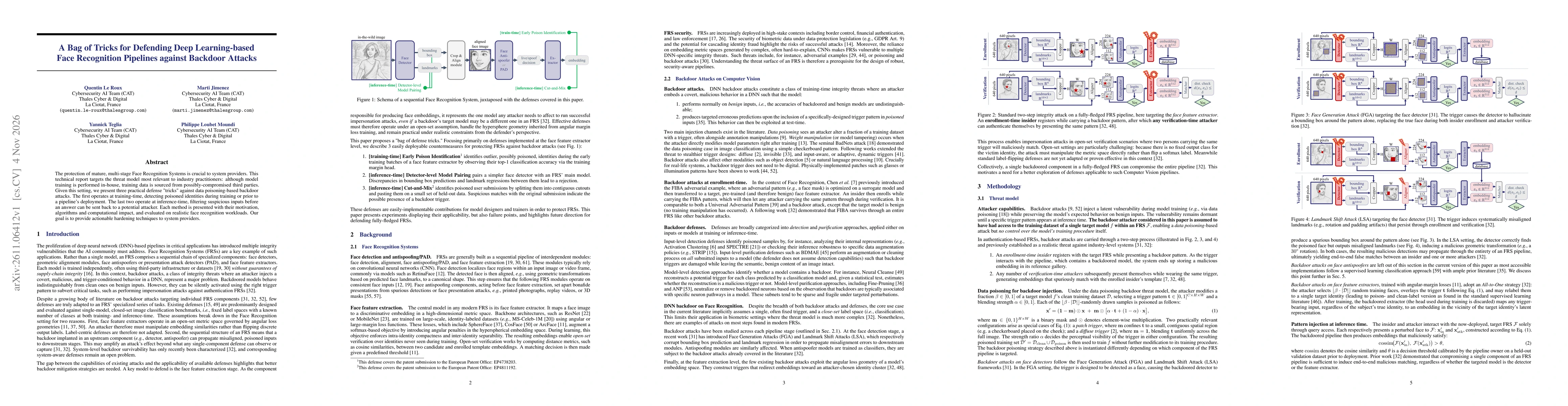
The paper proposes three practical defense tricks for face recognition pipelines: (1) Early Poison Identification, a training-time method that flags outlier identities by monitoring top-1 classification accuracy on early training batches; (2) Detector-level Model Pairing, an inference-time technique that cross-checks face detector outputs (bounding boxes and landmarks) between a simple detector and the main model to reject mismatches; and (3) Cut-and-Mix, an inference-time approach that splits the input image into patches, mixes them with held‑out data, and flags submissions whose patched embeddings still match the original, indicating a possible trigger.
SignificanceWhy the work matters
These defenses provide actionable, low‑overhead hardening techniques for industry‑deployed face recognition systems, addressing the open‑set nature of face embeddings and the lack of system‑level backdoor mitigations in prior work.
Technical contributionsWhat the work introduces
The paper introduces three easily deployable defense tricks—training‑time outlier detection, inference‑time detector model pairing, and inference‑time cut‑and‑mix patch analysis—accompanied by algorithms, computational impact assessments, and extensive evaluation on realistic face recognition workloads.
NoveltyHow it differs from prior work
It is the first work to present a suite of system‑level, open‑set compatible defenses specifically targeting backdoor attacks on the face feature extraction stage, combining training‑time identity outlier detection with two complementary inference‑time filtering strategies.
Future workQuestions that remain
- Develop more robust detection mechanisms for clean‑label and master‑face triggers to reduce false negatives.
- Extend the proposed tricks to other pipeline components such as anti‑spoofing/PAD modules.
- Validate the defenses on larger, real‑world deployment datasets and assess long‑term computational impact.
Discussion 0