A Classification of Low Genus Modular Curves
Abstract
Let $G$ be an open subgroup of $\mathrm{GL}_2(\widehat{\mathbb{Z}})$ satisfying $\det(G)=\widehat{\mathbb{Z}}^{\times}$ and $-I\in G$. Associated to $G$, there is a modular curve $X_G$ defined over $\mathbb{Q}$ which parametrizes elliptic curves with $G$-level structure. We give a classification of modular curves with genus equal to a fixed nonnegative integer $g$. In particular, we show that all modular curves of genus $g$ lie in finitely many families of $\mathbb{Q}^{\mathrm{ab}}$-twists of modular curves. We also describe an algorithm for computing all families of modular curves of a fixed genus $g$ and use this to compute projective models for these modular curves. This algorithm has been fully implemented for $g \leq 12$. In an appendix with Yongyuan Huang and Rakvi, we describe two algorithms, one for computing rational functions on modular curves given as quotients of two modular forms of the same weight, and the other for computing models for the generic fibers of universal elliptic curves $\mathcal{E}_G$, where $G\subset \mathrm{GL}_2(\widehat{\mathbb{Z}})$ is an open subgroup satisfying $\det(G)=\widehat{\mathbb{Z}}^{\times}$ and $-I\notin G$.
Analysis
AI-generated · verify against the original paper
Generated Jan 1, 0001ResultsWhat the authors found
- Theorem 1.1 (Classification) shows that for any non‑negative integer g, modular curves of genus g lie in finitely many families of \(\mathbb{Q}^{\mathrm{ab}}\)-twists of a single modular curve.
- An explicit algorithm is given that efficiently computes projective models for all modular curves of a fixed genus g.
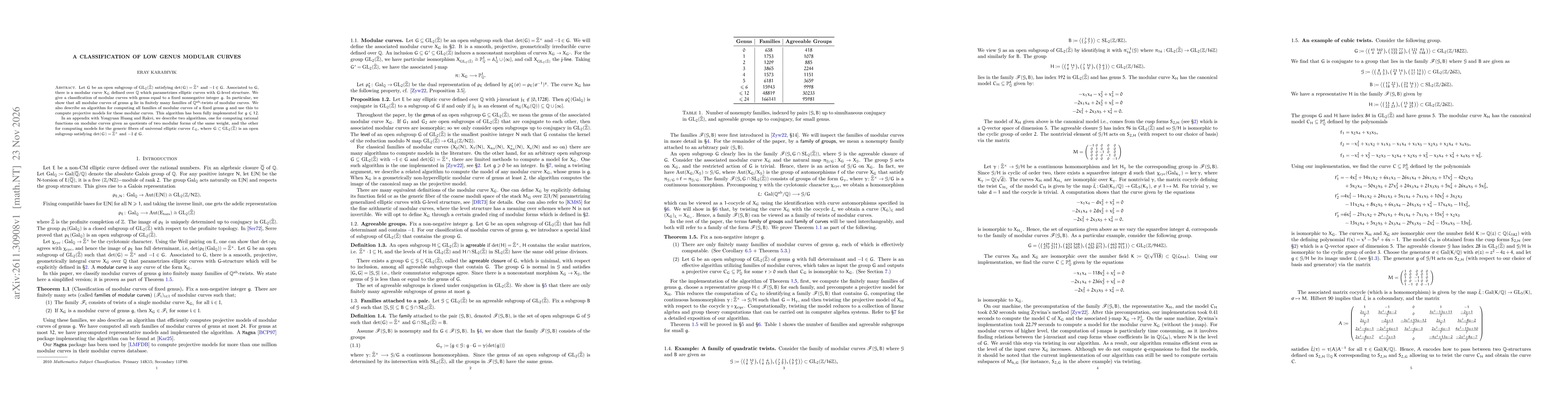
- The algorithm has been fully implemented for g \leq 12, and all families of modular curves have been computed for genus up to 24.
- A Magma package (Kar25) provides these models and has been used by the LMFDB to populate their modular curves database.
LimitationsWhere the findings need caution
- The implemented model computation is currently limited to genera g \leq 12, although families are known up to g \leq 24.
- The methods require the open subgroup G to satisfy det(G)=\widehat{\mathbb{Z}}^{\times} and contain -I.
MethodologyHow the work was done
The paper introduces the notion of agreeable subgroups and families of modular curves attached to pairs (G,B). It proves finiteness of such families for a fixed genus g, and describes an algorithm that, using twisting arguments and canonical maps, computes projective models for all modular curves of genus g. The algorithm is implemented in Magma and applied to genera up to 12, with precomputed representative models for genera up to 24.
SignificanceWhy the work matters
The classification and computational tools enable a systematic enumeration and modeling of low‑genus modular curves, facilitating large‑scale database construction (e.g., LMFDB) and further arithmetic investigations of elliptic curves with prescribed G‑level structures.
Technical contributionsWhat the work introduces
Provides a new finiteness classification of modular curves of fixed genus via Qab‑twist families, introduces agreeable subgroups, and delivers a practical algorithm with a Magma implementation for computing explicit projective models.
NoveltyHow it differs from prior work
First to show that all modular curves of a given low genus fall into finitely many Qab‑twist families and to supply an algorithmic framework that produces explicit models for these curves up to genus 12.
Discussion 0