A new detector, R2D, is proposed for RHIC-II to study quarkonia states in high-energy collisions, aiming to distinguish between suppression, absorption, and recombination effects.
Abstract
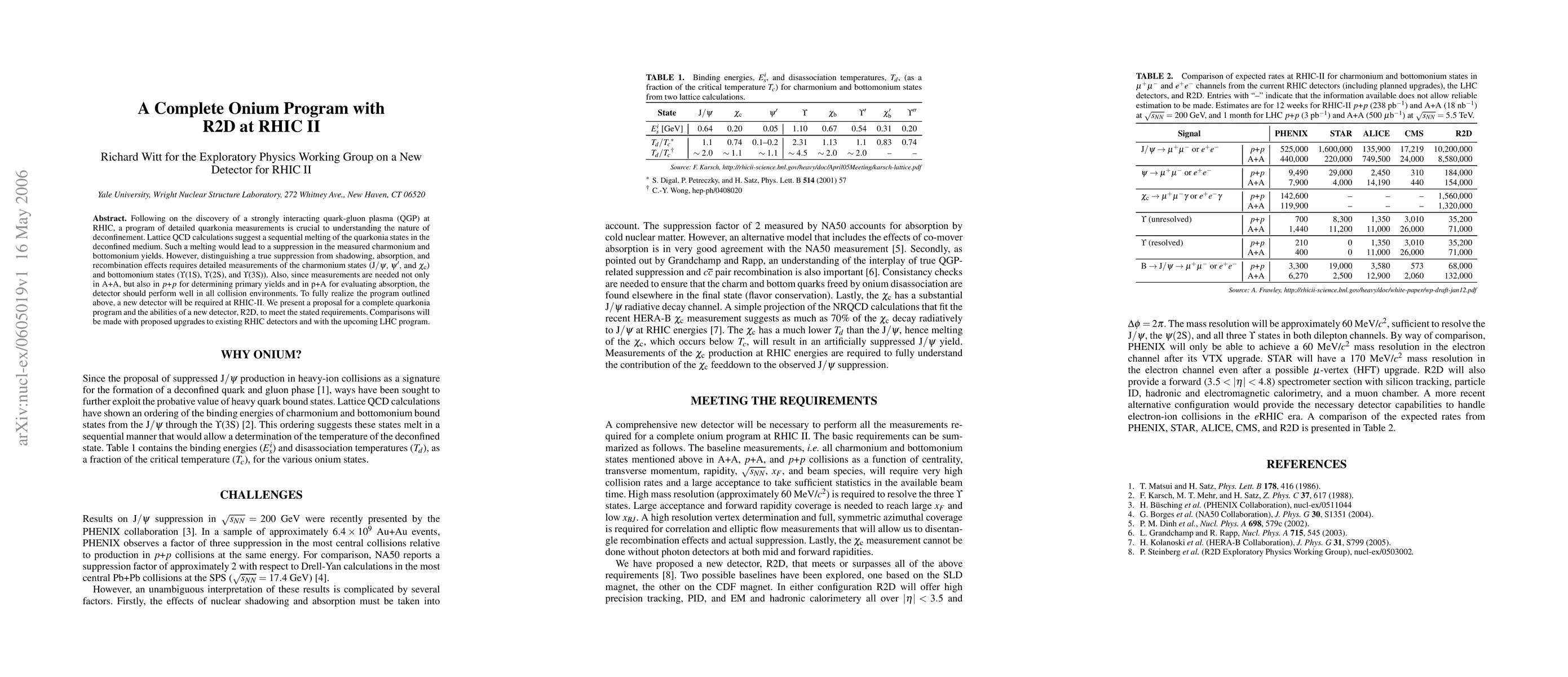
Following on the discovery of a strongly interacting quark-gluon plasma (QGP) at RHIC, a program of detailed quarkonia measurements is crucial to understanding the nature of deconfinement. Lattice QCD calculations suggest a sequential melting of the quarkonia states in the deconfined medium. Such a melting would lead to a suppression in the measured charmonium and bottomonium yields. However, distinguishing a true suppression from shadowing, absorption, and recombination effects requires detailed measurements of the charmonium states (J/psi, psi', and chi_c) and bottomonium states (Y(1S), Y(2S), and Y(3S)). Also, since measurements are needed not only in A+A, but also in p+p for determining primary yields and in p+A for evaluating absorption, the detector should perform well in all collision environments. To fully realize the program outlined above, a new detector will be required at RHIC-II. We present a proposal for a complete quarkonia program and the abilities of a new detector, R2D, to meet the stated requirements. Comparisons will be made with proposed upgrades to existing RHIC detectors and with the upcoming LHC program.
AI Key Findings
Get AI-generated insights about this paper's methodology, results, significance, and more — available when analysis has been generated.
Discussion 0