A computer-assisted counterexample to the planar Pompeiu and Schiffer conjectures
Abstract
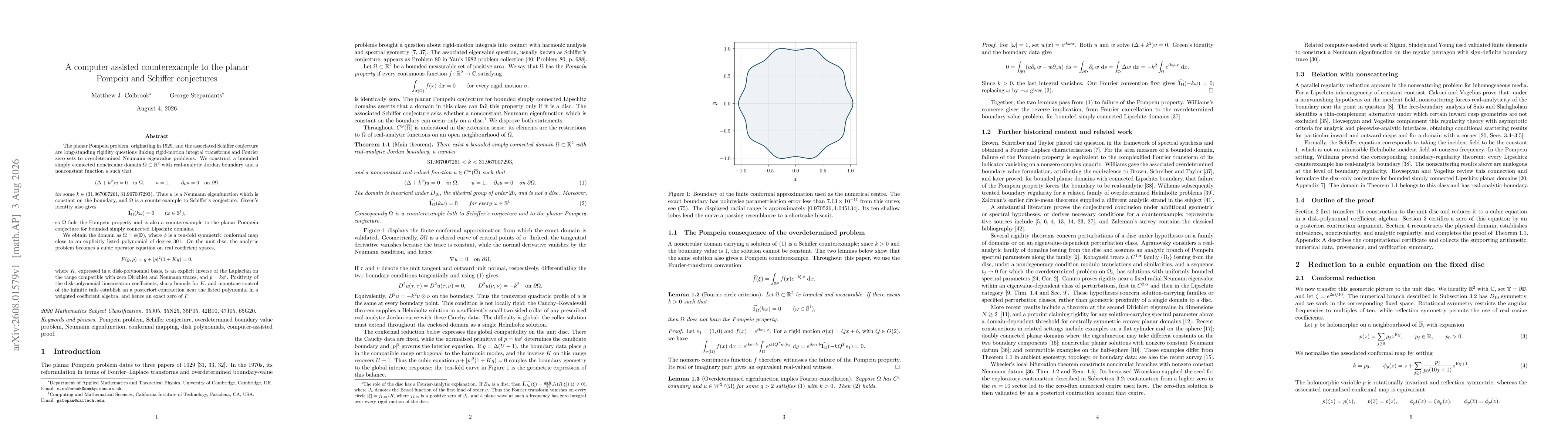
The planar Pompeiu problem, originating in 1929, and the associated Schiffer conjecture are long-standing rigidity questions linking rigid-motion integral transforms and Fourier zero sets to overdetermined Neumann eigenvalue problems. We construct a bounded simply connected noncircular domain $Ω\subset\mathbb{R}^2$ with real-analytic Jordan boundary and a nonconstant function $u$ such that $(Δ+k^2)u=0$ in $Ω$, $u=1,\partial_νu=0$ on $\partialΩ$ for some $k\in(31.967007261,31.967007293)$. Thus $u$ is a Neumann eigenfunction which is constant on the boundary, and $Ω$ is a counterexample to Schiffer's conjecture. Green's identity also gives $\widehat{\mathbf 1_Ω}(kω)=0$ $(ω\in\mathbb S^1)$, so $Ω$ fails the Pompeiu property and is also a counterexample to the planar Pompeiu conjecture for bounded simply connected Lipschitz domains. We obtain the domain as $Ω=φ(\mathbb{D})$, where $φ$ is a ten-fold symmetric conformal map close to an explicitly listed polynomial of degree $301$. On the unit disc, the analytic problem becomes a cubic operator equation on real coefficient spaces, $F(g,p)=g+|p|^2(1+Kg)=0$, where $K$, expressed in a disk-polynomial basis, is an explicit inverse of the Laplacian on the range compatible with zero Dirichlet and Neumann traces, and $p=kφ'$. Positivity of the disk-polynomial linearisation coefficients, sharp bounds for $K$, and monotone control of the infinite tails establish an a posteriori contraction near the listed polynomial in a weighted coefficient algebra, and hence an exact zero of $F$.
AI Key Findings
Get AI-generated insights about this paper's methodology, results, significance, and more — available when analysis has been generated.
Discussion 0