A deviatoric-stress closure for constitutive modeling of viscoelastic dynamics
Abstract
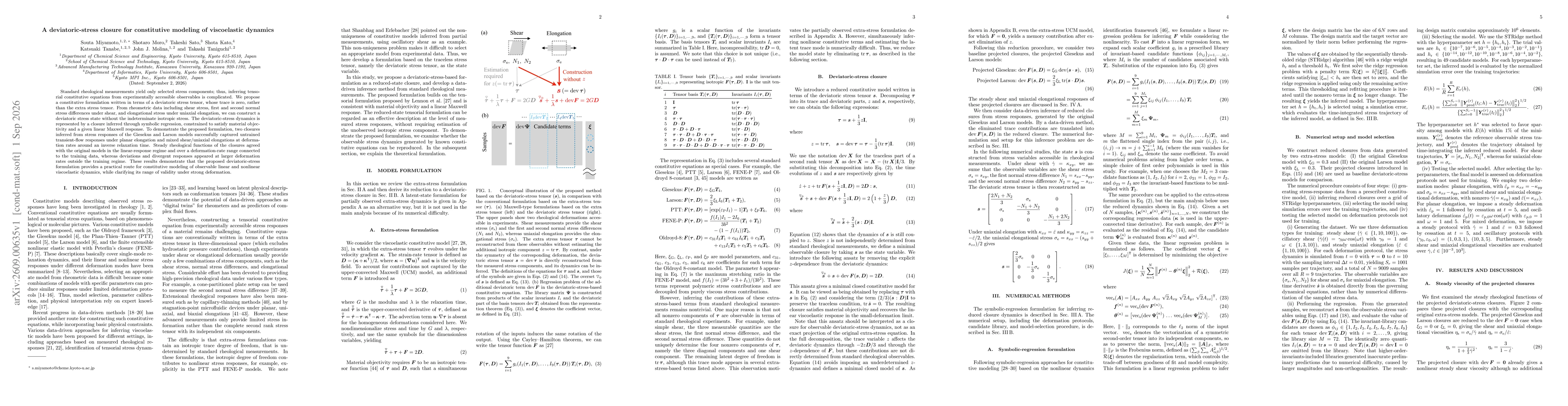
Standard rheological measurements yield only selected stress components; thus, inferring tensorial constitutive equations from experimentally accessible observables is complicated. We propose a constitutive formulation written in terms of a deviatoric stress tensor, whose trace is zero, rather than the extra stress tensor. From rheometric data including shear stress, first and second normal stress differences under shear, and elongational stress under uniaxial elongation, we can construct a deviatoric stress state without the indeterminate isotropic stress. The deviatoric-stress dynamics is represented by a closure inferred through symbolic regression, constrained to satisfy material objectivity and a given linear Maxwell response. To demonstrate the proposed formulation, two closures inferred from stress responses of the Giesekus and Larson models successfully captured untrained transient-flow responses under planar elongation and mixed shear/uniaxial elongations at deformation rates around an inverse relaxation time. Steady rheological functions of the closures agreed with the original models in the linear-response regime and over a deformation-rate range connected to the training data, whereas deviations and divergent responses appeared at larger deformation rates outside the training regime. These results demonstrate that the proposed deviatoric-stress formulation provides a practical route for constitutive modeling of observable linear and nonlinear viscoelastic dynamics, while clarifying its range of validity under strong deformation.
AI Key Findings
Get AI-generated insights about this paper's methodology, results, significance, and more — available when analysis has been generated.
Discussion 0