A generalization of Fueter's Theorem
Summary: This paper extends Fueter's theorem to a broader class of quaternionic functions beyond the original method, demonstrating its applicability in a wider context.
Abstract
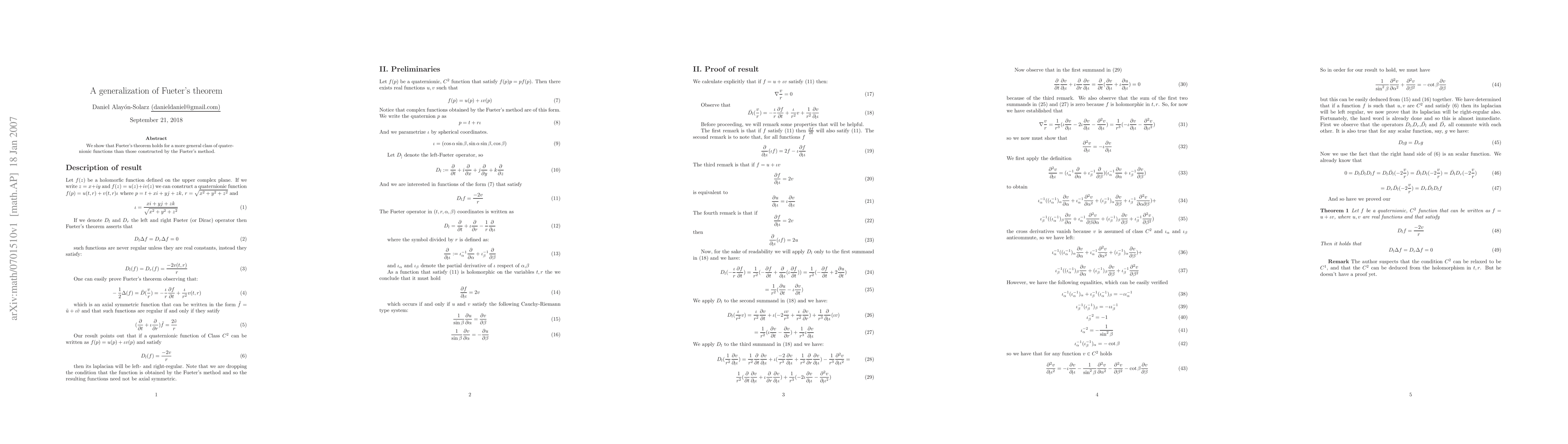
We show that Fueter's theorem holds for a more general class of quaternionic functions than those constructed by the Fueter's method.
Analysis
AI-generated · verify against the original paper
Generated Sep 2, 2025ResultsWhat the authors found
- The paper establishes that if a quaternionic, C2 function f(p) = u(p) + ιv(p) satisfies Dl f = -2vr, then its Laplacian Dl∆f = Dr∆f = 0.
- It proves that the operators Dl, Dr, ¯Dl, and ¯Dr commute with each other.
- The authors suspect that the C2 smoothness condition can potentially be relaxed to C1, with C2 derivable from holomorphicity in t and r.
LimitationsWhere the findings need caution
- The paper does not provide a proof for relaxing the C2 condition to C1.
- The generalization might not cover all possible classes of quaternionic functions outside the Fueter's method construction.
MethodologyHow the work was done
The paper generalizes Fueter's theorem by showing it holds for a broader class of quaternionic functions beyond those constructed by the Fueter's method. It uses preliminaries involving quaternionic functions, the left-Fueter operator, and Cauchy-Riemann type systems.
SignificanceWhy the work matters
This research extends Fueter's theorem, which has applications in quaternionic analysis and differential geometry, to a wider class of functions, potentially broadening its applicability in these fields.
Technical contributionsWhat the work introduces
The paper presents a generalization of Fueter's theorem, demonstrating its applicability to a more extensive class of quaternionic functions and proving key properties of associated operators.
NoveltyHow it differs from prior work
This work extends previous research by generalizing Fueter's theorem, potentially opening new avenues for its application in quaternionic analysis and related fields.
Future workQuestions that remain
- Investigate if the C2 condition can indeed be relaxed to C1 while maintaining the theorem's validity.
- Explore further generalizations of Fueter's theorem to even broader classes of quaternionic functions.
Discussion 0