A Microwave-Photonics Formulation of the Rydberg-Atom Receiver
Abstract
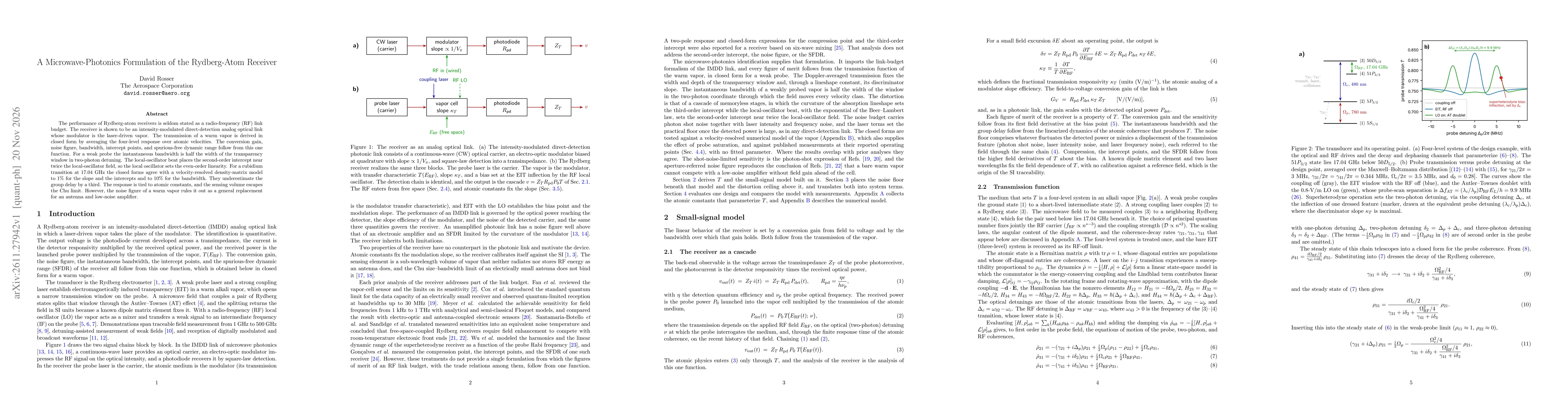
The performance of Rydberg-atom receivers is seldom stated as a radio-frequency (RF) link budget. The receiver is shown to be an intensity-modulated direct-detection analog optical link whose modulator is the laser-driven vapor. The transmission of a warm vapor is derived in closed form by averaging the four-level response over atomic velocities. The conversion gain, noise figure, bandwidth, intercept points, and spurious-free dynamic range follow from this one function. For a weak probe the instantaneous bandwidth is half the width of the transparency window in two-photon detuning. The local-oscillator beat places the second-order intercept near twice the local-oscillator field, so the local oscillator sets the even-order linearity. For a rubidium transition at 17.04 GHz the closed forms agree with a velocity-resolved density-matrix model to 1% for the slope and the intercepts and to 10% for the bandwidth. They underestimate the group delay by a third. The response is tied to atomic constants, and the sensing volume escapes the Chu limit. However, the noise figure of a warm vapor rules it out as a general replacement for an antenna and low-noise amplifier.
Analysis
AI-generated · verify against the original paper
Generated Jan 1, 0001ResultsWhat the authors found
- The closed-form transmission agrees with a velocity-resolved density-matrix model to within 1% for slope and intercept points.
- Bandwidth predictions match the model within 10%, though the group delay is underestimated by about one third.
- Conversion gain, noise figure, bandwidth, intercept points, and SFDR are all obtained analytically from the derived transmission function.
- For a weak probe, the instantaneous bandwidth equals half the width of the EIT transparency window in two‑photon detuning.
- The local‑oscillator beat sets the second‑order intercept near twice the LO field, making the LO the determinant of even‑order linearity.
LimitationsWhere the findings need caution
- The warm‑vapor noise figure is too high for the receiver to serve as a general replacement for antenna and low‑noise amplifier front‑ends.
- The analytical model underestimates the group delay by roughly one third compared to the density‑matrix simulation.
MethodologyHow the work was done
Derives a closed-form expression for the transmission of a warm vapor by averaging the four-level atomic response over velocity distributions, then extracts RF link budget parameters (conversion gain, noise figure, bandwidth, intercept points, SFDR) from this single function; validates against a velocity-resolved density-matrix model.
SignificanceWhy the work matters
Provides a unified analytical framework that ties Rydberg‑atom receiver performance directly to atomic constants, enabling self‑calibrated RF link budgeting and revealing that the sensing volume bypasses the Chu limit, though warm‑vapor noise limits practical replacement of conventional antennas.
Technical contributionsWhat the work introduces
Introduces a single closed-form transmission function for warm Rydberg vapors that simultaneously yields all key RF link metrics, validated against detailed density‑matrix simulations.
NoveltyHow it differs from prior work
First formulation that consolidates conversion gain, noise figure, bandwidth, intercept points, and SFDR of a Rydberg‑atom receiver into one analytical expression derived from atomic physics, linking receiver performance directly to fundamental constants.
Discussion 0