Abstract
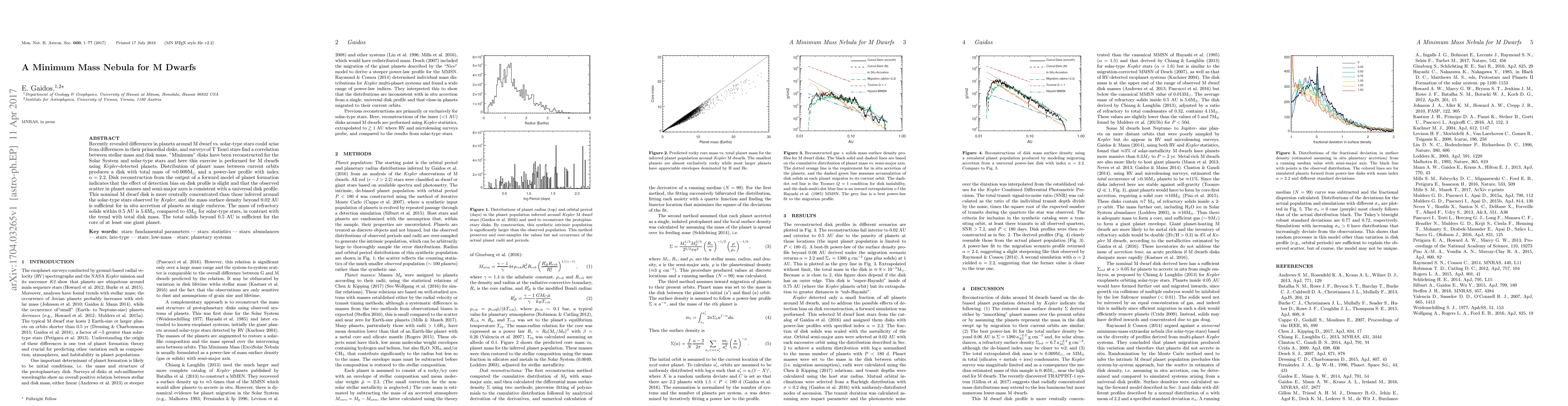
Recently revealed differences in planets around M dwarf vs. solar-type stars could arise from differences in their primordial disks, and surveys of T Tauri stars find a correlation between stellar mass and disk mass. "Minimum" disks have been reconstructed for the Solar System and solar-type stars and here this exercise is performed for M dwarfs using Kepler-detected planets. Distribution of planet mass between current orbits produces a disk with total mass of ~0.009Msun and a power-law profile with index 2.2. Disk reconstruction from the output of a forward model of planet formation indicates that the effect of detection bias on disk profile is slight and that the observed scatter in planet masses and semi-major axes is consistent with a universal disk profile. This nominal M dwarf disk is more centrally concentrated than those inferred around the solar-type stars observed by Kepler, and the mass surface density beyond 0.02 AU is sufficient for in situ accretion of planets as single embryos. The mass of refractory solids within 0.5 AU is 5.6Mearth compared to 4Mearth for solar-type stars, in contrast with the trend with total disk mass. The total solids beyond 0.5 AU is sufficient for the core of at least one giant planet.
AI Key Findings
Get AI-generated insights about this paper's methodology, results, significance, and more — available when analysis has been generated.
Discussion 0