A No-Reference Deep Learning Quality Assessment Method for Super-resolution Images Based on Frequency Maps
This paper proposes a no-reference deep learning method for assessing the quality of super-resolution images based on frequency maps. The method extracts high- and low-frequency maps using Sobel operator and smooth approximations, then employs a two-stream network to derive quality features, which are finally regressed into a single quality score, outperforming existing IQA models.
Abstract
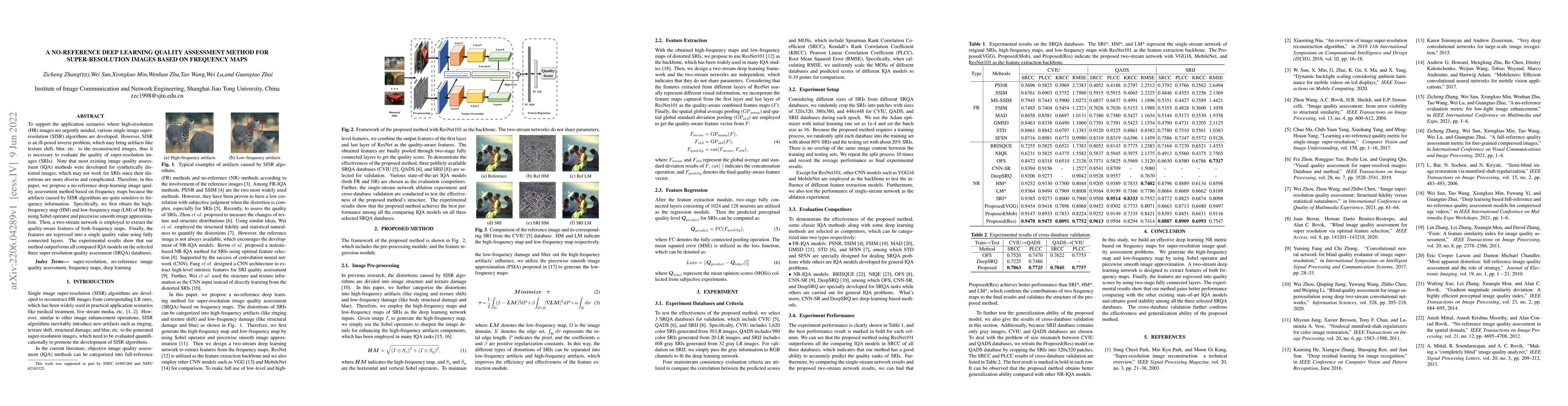
To support the application scenarios where high-resolution (HR) images are urgently needed, various single image super-resolution (SISR) algorithms are developed. However, SISR is an ill-posed inverse problem, which may bring artifacts like texture shift, blur, etc. to the reconstructed images, thus it is necessary to evaluate the quality of super-resolution images (SRIs). Note that most existing image quality assessment (IQA) methods were developed for synthetically distorted images, which may not work for SRIs since their distortions are more diverse and complicated. Therefore, in this paper, we propose a no-reference deep-learning image quality assessment method based on frequency maps because the artifacts caused by SISR algorithms are quite sensitive to frequency information. Specifically, we first obtain the high-frequency map (HM) and low-frequency map (LM) of SRI by using Sobel operator and piecewise smooth image approximation. Then, a two-stream network is employed to extract the quality-aware features of both frequency maps. Finally, the features are regressed into a single quality value using fully connected layers. The experimental results show that our method outperforms all compared IQA models on the selected three super-resolution quality assessment (SRQA) databases.
AI Key Findings
Get AI-generated insights about this paper's methodology, results, significance, and more — available when analysis has been generated.
Discussion 0