This review examines advancements in carbon nanotube fibre composites, highlighting two emerging high-performance grades and challenges in fabricating large unidirectional fabrics. Future research should focus on creating large-scale CNT fibre laminate composites and exploring multifunctional composites with integrated energy functions.
Abstract
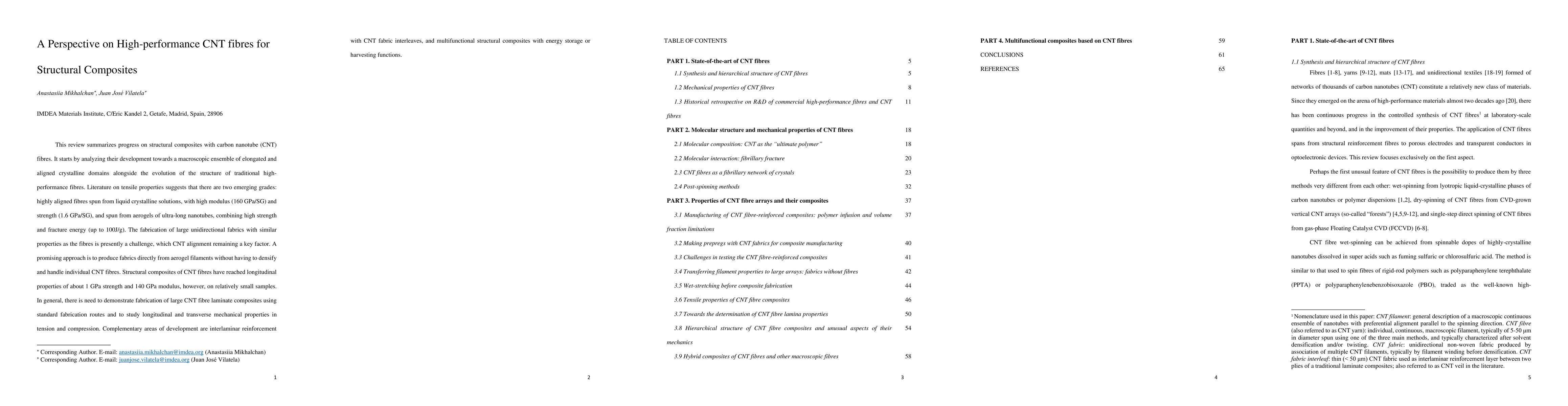
This review summarizes progress on structural composites with carbon nanotube fibres. It starts by analyzing their development towards a macroscopic ensemble of elongated and aligned crystalline domains, alongside the evolution of the structure of traditional high-performance fibres. Literature on tensile properties suggests that there are two emerging grades: highly aligned fibres spun from liquid crystalline solutions, with high modulus and strength, and spun from aerogels of ultra long-nanotubes, combining high strength and fracture energy. The fabrication of large unidirectional fabrics with similar properties as the fibres is presently a challenge, which CNT alignment remaining a key factor. A promising approach is to produce fabrics directly from aerogel filaments without having to densify and handle individual CNT fibres. Structural composites of CNT fibres have reached high longitudinal properties, however, on relatively small samples. In general, there is need to demonstrate fabrication of large CNT fibre laminate composites using standard fabrication routes and to study longitudinal and transverse mechanical properties in tension and compression. Complementary areas of development are interlaminar reinforcement with CNT fabric interleaves, and multifunctional structural composites with energy storage or harvesting functions.
AI Key Findings
Get AI-generated insights about this paper's methodology, results, significance, and more — available when analysis has been generated.
Discussion 0