A Phase-Balanced Differential Rydberg-Atom Quantum Receiver for Weak GNSS Signal Detection
Abstract
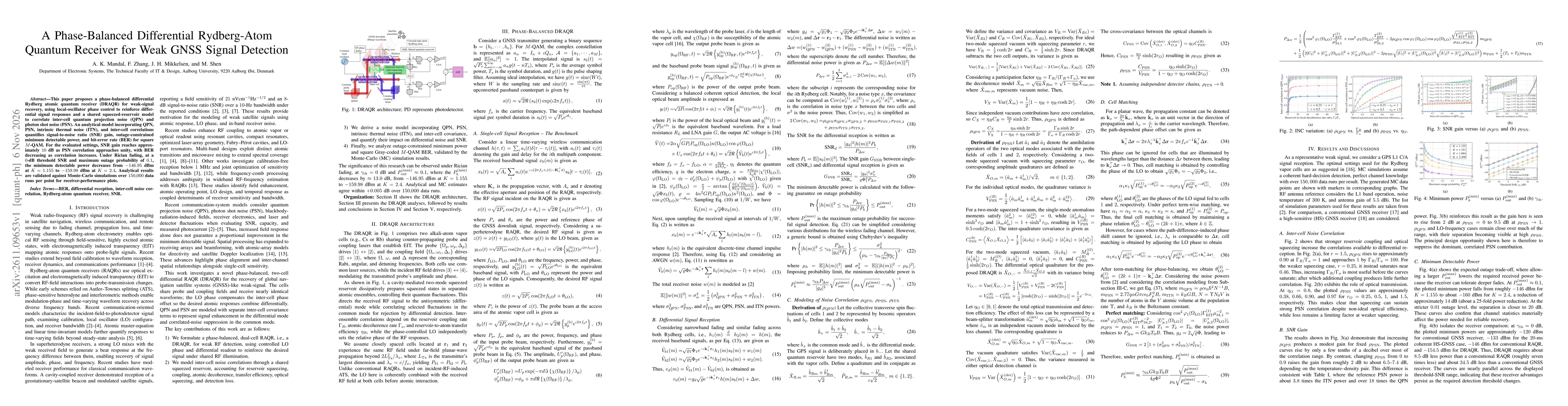
This paper proposes a phase-balanced differential Rydberg atomic quantum receiver (DRAQR) for weak-signal recovery, using local-oscillator phase control to reinforce differential signal responses and a shared squeezed-reservoir model to correlate inter-cell quantum projection noise (QPN) and photon shot noise (PSN). An analytical model incorporating QPN, PSN, intrinsic thermal noise (ITN), and inter-cell correlations quantifies signal-to-noise ratio (SNR) gain, outage-constrained minimum detectable power, and bit-error rate (BER) for square $M$-QAM. For the evaluated settings, SNR gain reaches approximately $10$~dB as PSN correlation approaches unity, with BER decreasing as correlation increases. Under Rician fading, at a $0$-dB threshold SNR and maximum outage probability of $0.1$, the minimum detectable power decreases from $-146.95$~dBm at $K=1.155$ to $-159.98$~dBm at $K=2.4$. Analytical results are validated against Monte-Carlo simulations over $150{,}000$ data runs per point for receiver-performance plots.
Analysis
AI-generated · verify against the original paper
Generated Jan 1, 0001ResultsWhat the authors found
- SNR gain reaches approximately 10 dB as PSN correlation approaches unity.
- BER decreases with increasing noise correlation, achieving up to 80‑fold reduction for 64‑QAM at high correlation.
- Minimum detectable power improves by ~13‑14 dB under Rician fading (from –146.95 dBm at K=1.155 to –159.98 dBm at K=2.4).
- DRAQR requires about 8.5 dB less power than a conventional RAQR and ~34.5 dB less than a conventional GNSS receiver for the same detection threshold.
- At BER≈10⁻³, DRAQR needs an average SNR of ≈‑4 dB, compared to +5 dB for conventional RAQR and +13‑15 dB for high‑sensitivity GNSS.
LimitationsWhere the findings need caution
- The reported gains depend on assumed inter‑cell covariances and ideal phase balance.
- Performance relies on strong reservoir coupling and optical squeezing, which may be limited in practice.
- Experimental validation is lacking; the study assumes perfect LO phase control and neglects implementation losses.
MethodologyHow the work was done
The paper proposes a phase‑balanced differential Rydberg‑atom quantum receiver (DRAQR) that uses local‑oscillator phase control to reinforce differential signal responses and a shared squeezed‑reservoir model to correlate inter‑cell quantum projection noise (QPN) and photon shot noise (PSN). An analytical model incorporating QPN, PSN, intrinsic thermal noise (ITN) and inter‑cell correlations quantifies SNR gain, outage‑constrained minimum detectable power, and BER for square M‑QAM, and the model is validated with Monte‑Carlo simulations of over 150,000 data runs per point.
SignificanceWhy the work matters
The work demonstrates that coordinated signal and noise modes across two vapor cells can substantially enhance weak‑signal recovery for GNSS applications, delivering notable SNR and BER improvements that enable detection under deep fading conditions.
Technical contributionsWhat the work introduces
Introduces a dual‑cell, phase‑balanced differential Rydberg‑atom receiver with LO phase control and a shared squeezed reservoir, together with a comprehensive analytical noise model validated by extensive Monte‑Carlo simulations.
NoveltyHow it differs from prior work
First demonstration of combining LO phase balancing with inter‑cell quantum noise correlation via a squeezed reservoir to achieve differential detection gains in Rydberg‑atom quantum receivers.
Future workQuestions that remain
- Conduct experimental measurements of QPN and PSN correlations.
- Assess the impact of phase errors, cell mismatch, and implementation losses on receiver performance.
- Explore optimization of inter‑cell covariance and squeezing parameters in practical hardware.
Discussion 0