A smooth BTZ black bounce with an extremal null throat
Abstract
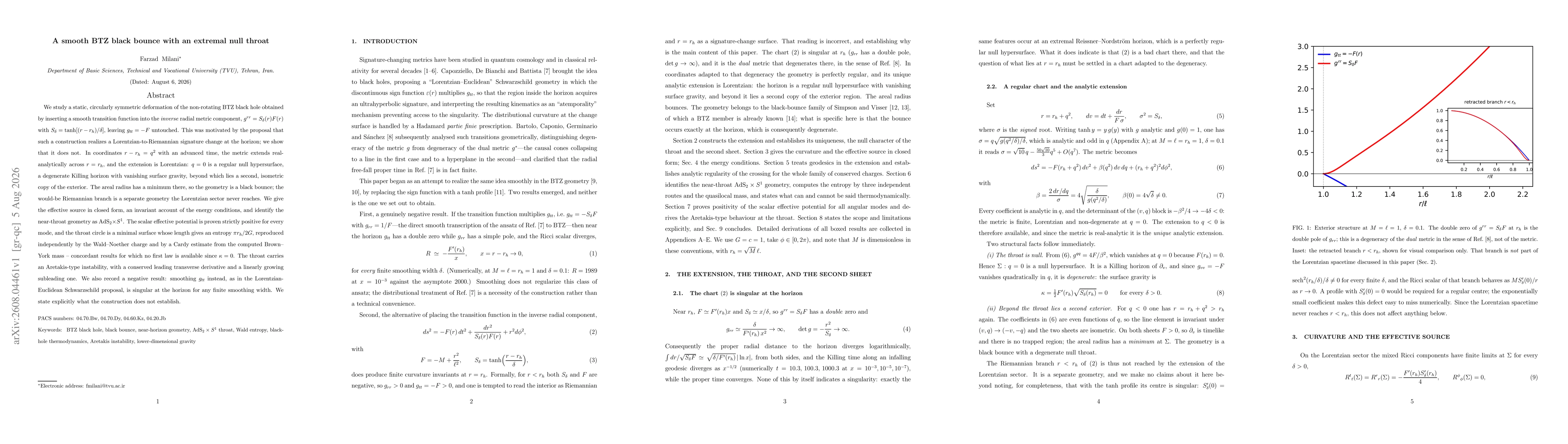
We study a static, circularly symmetric deformation of the non-rotating BTZ black hole obtained by inserting a smooth transition function into the \emph{inverse} radial metric component, $g^{rr}=S_δ(r)F(r)$ with $S_δ=\tanh[(r-r_h)/δ]$, leaving $g_{tt}=-F$ untouched. This was motivated by the proposal that such a construction realizes a Lorentzian-to-Riemannian signature change at the horizon; we show that it does not. In coordinates $r-r_h=q^2$ with an advanced time, the metric extends real-analytically across $r=r_h$, and the extension is Lorentzian: $q=0$ is a regular null hypersurface, a degenerate Killing horizon with vanishing surface gravity, beyond which lies a second, isometric copy of the exterior. The areal radius has a minimum there, so the geometry is a black bounce; the would-be Riemannian branch is a separate geometry the Lorentzian sector never reaches. We give the effective source in closed form, an invariant account of the energy conditions, and identify the near-throat geometry as AdS$_2\times S^1$. The scalar effective potential is proven strictly positive for every mode, and the throat circle is a minimal surface whose length gives an entropy $πr_h/2G$, reproduced independently by the Wald--Noether charge and by a Cardy estimate from the computed Brown--York mass -- concordant results for which no first law is available since $κ=0$. The throat carries an Aretakis-type instability, with a conserved leading transverse derivative and a linearly growing subleading one. We also record a negative result: smoothing $g_{tt}$ instead, as in the Lorentzian-Euclidean Schwarzschild proposal, is singular at the horizon for any finite smoothing width. We state explicitly what the construction does not establish.
Analysis
AI-generated · verify against the original paper
Generated Aug 7, 2026ResultsWhat the authors found
- The spacetime extends real-analytically across r = r_h with q = 0 as a regular null hypersurface; beyond this lies a second isometric exterior, yielding a black bounce.
- The throat has AdS_2 × S^1 near-horizon geometry and the areal radius attains a minimum at r_h, producing a non-singular bounce instead of a singular interior.
- The throat carries an Aretakis-type instability with a conserved leading transverse derivative and a linearly growing subleading derivative, indicating marginal stability features on the null throat.
- The entropy associated with the throat circle is π r_h / (2G), reproduced by both Wald–Noether charge and Cardy-based Brown–York mass estimates, despite κ = 0 forbidding a standard first law.
- Smoothing g_{tt} instead of g^{rr} does not regularize the horizon and remains singular for any finite smoothing width.
LimitationsWhere the findings need caution
- No standard first-law formulation due to vanishing surface gravity (κ = 0) limits conventional black hole thermodynamics interpretation.
- Stability analysis is restricted to Aretakis-type instabilities at the throat; full nonlinear dynamical evolution under perturbations is not explored.
- Results are specialized to non-rotating BTZ-like setup; extensions to higher dimensions or inclusion of rotation are not addressed.
- Dependence on the smoothing width δ is analyzed implicitly; a systematic parameter sweep across δ is not detailed.
- The construction does not establish a Lorentzian-to-Riemannian signature change, only a non-significant implication for that interpretation.
MethodologyHow the work was done
Introduce a smooth transition function into the inverse radial metric component g^{rr} = S_δ(r) F(r) with S_δ = tanh[(r − r_h)/δ], leaving g_{tt} = -F unchanged; analyze the resulting geometry through analytic extension across r = r_h in coordinates r − r_h = q^2 with advanced time, proving Lorentzian extension with a regular null hypersurface and degenerate Killing horizon; compute the effective source, verify energy conditions invariantly, and identify near-throat geometry as AdS_2 × S^1; evaluate thermodynamic quantities via Wald–Noether charge and Brown–York mass, and study perturbative stability including Aretakis-type behavior; contrast with smoothing g_{tt}, showing singular horizon for any finite width.
SignificanceWhy the work matters
Provides a concrete, analytically tractable BTZ-based black bounce model with a degenerate null throat, clarifying signature properties, energy conditions, and thermodynamic-like quantities in a lower-dimensional gravity setting; demonstrates the non-viability of Lorentzian-to-Riemannian signature change at the horizon for this construction and highlights a novel AdS_2 × S^1 throat with Aretakis-type instability relevance.
Technical contributionsWhat the work introduces
Proposes a smooth deformation of the BTZ metric via g^{rr} = S_δ(r) F(r) that yields a regular null throat with AdS_2 × S^1 near-horizon geometry, provides closed-form effective source and energy-condition accounting, computes throat entropy through multiple independent methods (Wald–Noether and Cardy/Brown–York), and identifies an Aretakis-type instability at the throat.
NoveltyHow it differs from prior work
Delivers a concrete black-bounce construction within BTZ geometry by modifying the inverse radial metric rather than g_{tt}, demonstrates a regular null throat with vanishing surface gravity, and unifies geometric, energetic, and thermodynamic perspectives in a lower-dimensional setting, while clarifying the insufficiency of a Lorentzian-to-Riemannian signature change in this context.
Future workQuestions that remain
- Explore dynamical evolution under perturbations to assess nonlinear stability and possible end-states of the black bounce.
- Generalize to rotating BTZ spacetimes and/or higher-dimensional analogues to test robustness of the AdS_2 × S^1 throat feature.
- Investigate alternative transition profiles and their impact on entropy, energy conditions, and possible connections to holographic descriptions.
- Develop a more complete thermodynamic framework for degenerate horizons with κ = 0, possibly via extended or generalized first laws.
- Examine quantum field behavior on the throat to understand potential observational consequences or signature imprints.
Discussion 0