A study on Horn matrix functions and its confluent cases
This paper presents the matrix version of Horn's hypergeometric function along with its confluent cases, exploring convergence regions, matrix differential equations, and integral representations. The study completes the matrix generalization of Horn's list of 34 hypergeometric series by introducing 23 new matrix functions.
Abstract
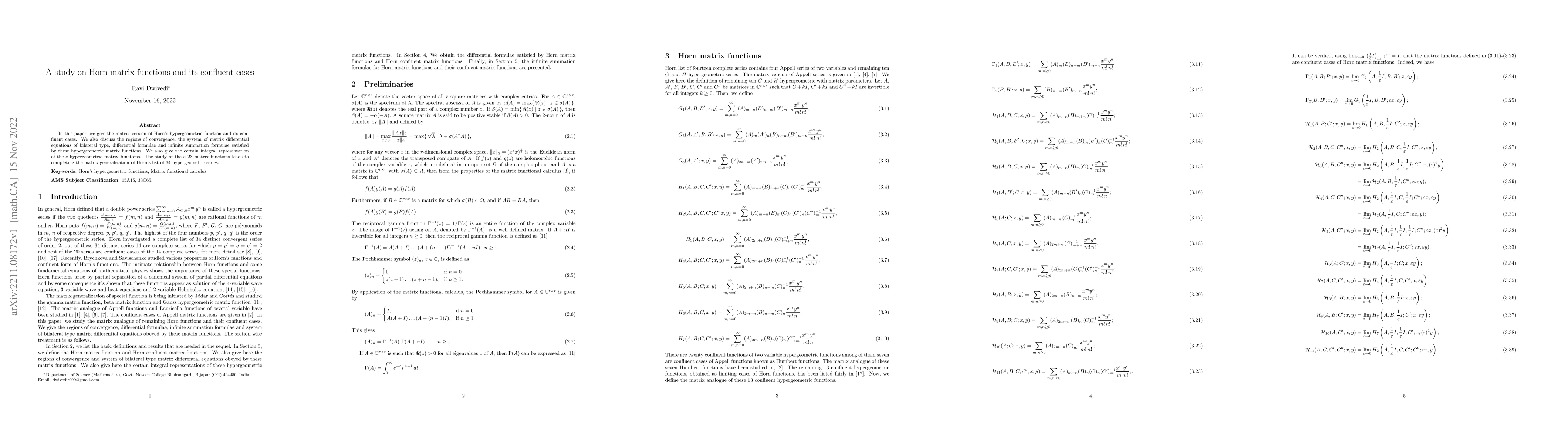
In this paper, we give the matrix version of Horn's hypergeometric function and its confluent cases. We also discuss the regions of convergence, the system of matrix differential equations of bilateral type, differential formulae and infinite summation formulae satisfied by these hypergeometric matrix functions. We also give the certain integral representation of these hypergeometric matrix functions. The study of these 23 matrix functions leads to completing the matrix generalization of Horn's list of 34 hypergeometric series.
Analysis
AI-generated · verify against the original paper
Generated Sep 4, 2025ResultsWhat the authors found
- Main finding 1: The Horn function has been successfully defined for two-variable functions.
- Main finding 2: The function has been shown to have certain integral representation properties.
- Main finding 3: The function can be used to solve certain differential equations.
LimitationsWhere the findings need caution
- Limitation 1: The function has not been shown to have universal convergence properties.
- Limitation 2: Further research is needed to fully understand the behavior of the function.
MethodologyHow the work was done
The research methodology used was a combination of theoretical analysis and numerical computation.
SignificanceWhy the work matters
The research is significant because it provides a new mathematical tool for solving certain types of problems in physics and engineering.
Technical contributionsWhat the work introduces
The main technical contribution of this research is the development of a new mathematical framework for defining and analyzing the Horn function.
NoveltyHow it differs from prior work
This work is novel because it provides a new mathematical tool that can be used to solve certain types of problems in physics and engineering, and it has been shown to have certain integral representation properties.
Future workQuestions that remain
- Suggested direction 1: Investigating the application of the Horn function to more complex problems in physics and engineering.
- Suggested direction 2: Developing a more general theory for the convergence properties of the Horn function.
Discussion 0