A very ample lattice polytope with a non-unimodal $h^*$-vector
The authors construct a very ample lattice polytope whose h*-vector (from its Ehrhart series) is non-unimodal, answering a question by Ferroni and Higashitani (and related to Balletti). The example is the Cartesian square of a polytope from a known class by Lasoń and Michalek, and it highlights that very ampleness does not guarantee a unimodal h*-vector, though the broader IDP unimodality question remains open.
Abstract
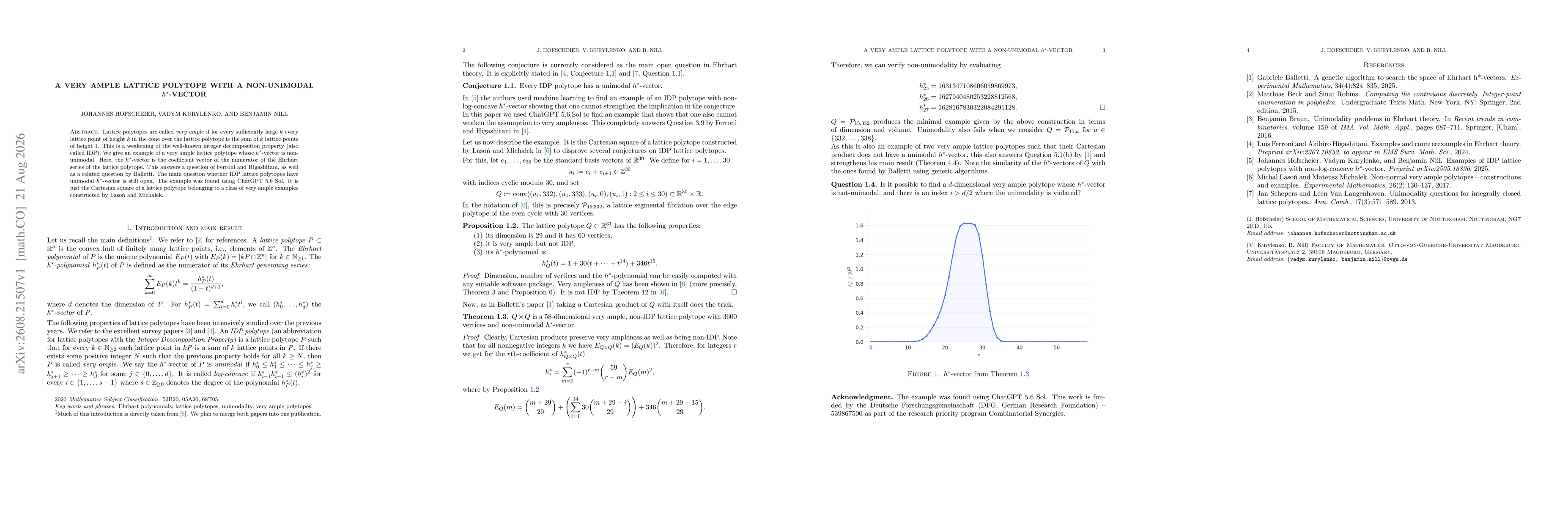
Lattice polytopes are called very ample if for every sufficiently large $k$ every lattice point of height $k$ in the cone over the lattice polytope is the sum of $k$ lattice points of height $1$. This is a weakening of the well-known integer decomposition property (also called IDP). We give an example of a very ample lattice polytope whose $h^*$-vector is non-unimodal. Here, the $h^*$-vector is the coefficient vector of the numerator of the Ehrhart series of the lattice polytope. This answers a question of Ferroni and Higashitani, as well as a related question by Balletti. The main question whether IDP lattice polytopes have unimodal $h^*$-vector is still open. The example was found using ChatGPT 5.6 Sol. It is just the Cartesian square of a lattice polytope belonging to a class of very ample examples constructed by Lasoń and Michalek.
AI Key Findings
Get AI-generated insights about this paper's methodology, results, significance, and more — available when analysis has been generated.
Discussion 0