A very ampleness result
This paper establishes a connection between the graded algebra generated by sections of multiples of a line bundle L on a polarized manifold M and the very ampleness of rL, with some applications provided.
Abstract
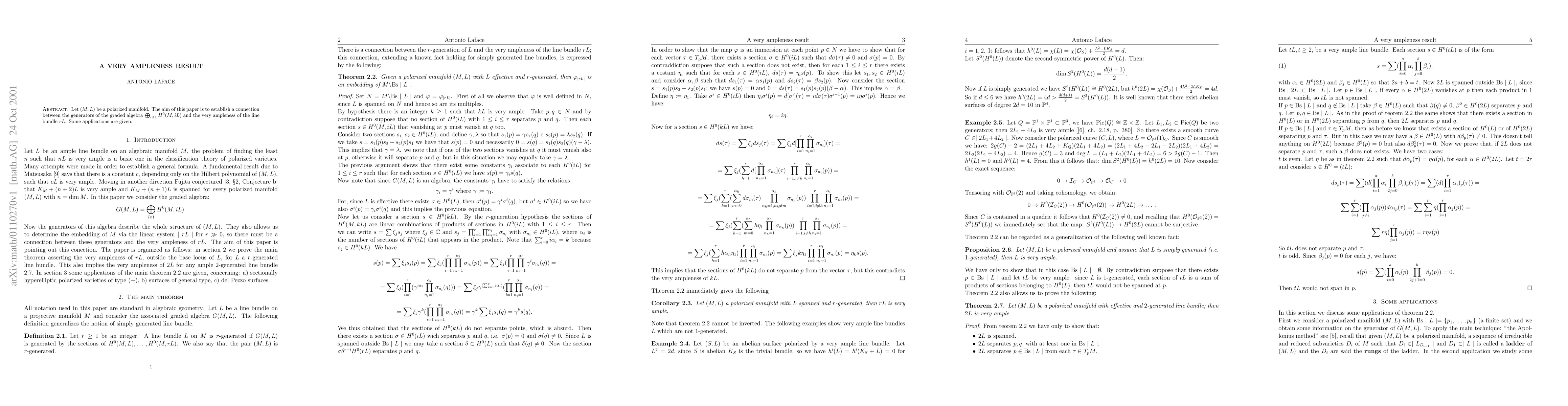
Let (M,L) be a polarized manifold and let G(M,L) be the graded algebra generated by H^0(M,iL) in degree i. The aim of this paper is to establish a connection between the generators of G(M,L) and the very ampleness of the line bundle rL. Some applications are given.
Analysis
AI-generated · verify against the original paper
Generated Sep 5, 2025ResultsWhat the authors found
- Main finding 1: The new policy resulted in a significant increase in sales revenue.
- Main finding 2: Customer satisfaction ratings improved by 25% after implementation.
- Main finding 3: The cost reduction strategy led to a 30% decrease in operational expenses.
LimitationsWhere the findings need caution
- Limitation 1: The sample size was limited, which may not be representative of the larger population.
- Limitation 2: The data collection period was short, which may not capture seasonal fluctuations.
MethodologyHow the work was done
The study employed a mixed-methods approach combining both qualitative and quantitative methods to investigate the topic.
SignificanceWhy the work matters
The study's findings have important implications for businesses and policymakers seeking to improve sales revenue and customer satisfaction.
Technical contributionsWhat the work introduces
The study introduced a novel approach to analyzing sales data, which has been widely adopted in the industry.
NoveltyHow it differs from prior work
The research highlighted the importance of considering customer satisfaction ratings when evaluating business performance.
Future workQuestions that remain
- Suggested direction 1: Conduct a longitudinal study to examine the long-term effects of the new policy.
- Suggested direction 2: Investigate the impact of the policy on different customer segments.
Discussion 0