Ab Initio Random Matrix Theory of Molecular Electronic Structure
Abstract
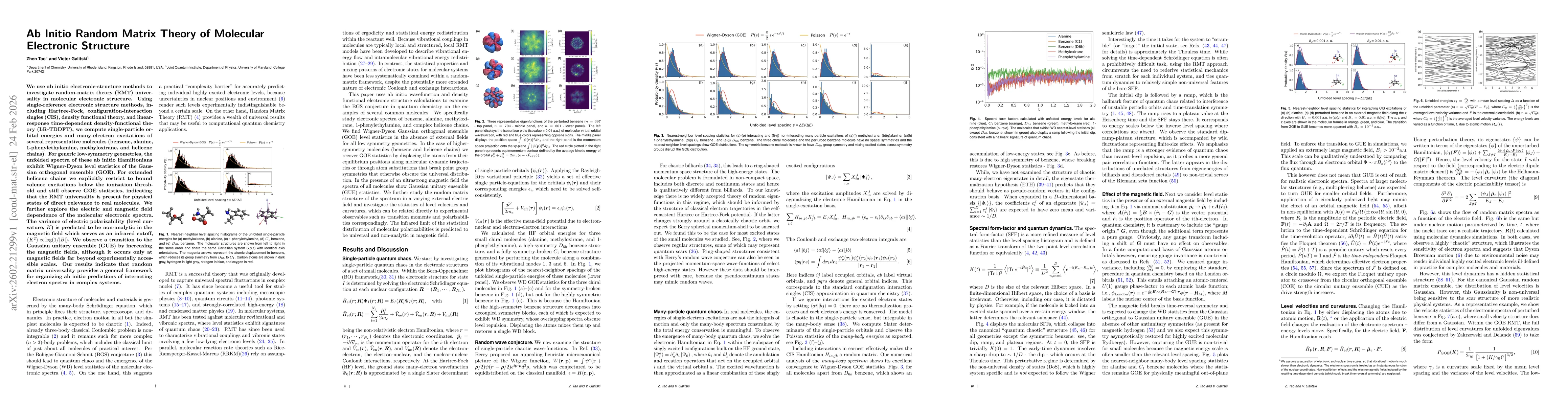
We use ab initio electronic-structure methods to investigate random-matrix theory (RMT) universality in molecular electronic structure. Using single-reference electronic structure methods, including Hartree-Fock, configuration-interaction singles (CIS), density functional theory, and linear-response time-dependent density-functional theory, we compute single-particle orbital energies and many-electron excitations of several representative molecules (benzene, alanine, 1-phenylethylamine, methyloxirane, and helicene chains). For generic low-symmetry geometries, the unfolded spectra of these ab initio Hamiltonians exhibit Wigner-Dyson level statistics of the Gaussian orthogonal ensemble (GOE). For extended helicene chains we explicitly restrict to bound valence excitations below the ionization threshold and still observe GOE statistics, indicating that the RMT universality is present for physical states of direct relevance to real molecules. We further explore the electric and magnetic field dependence of the molecular electronic spectra. The variance of electric polarizability (level curvature K) is predicted to be non-analytic in the magnetic field which serves as an infrared cutoff,
Analysis
AI-generated · verify against the original paper
Generated Feb 26, 2026ResultsWhat the authors found
- Unfolded spectra of low-symmetry molecules exhibit Wigner-Dyson GOE statistics, confirming RMT universality in ab initio Hamiltonians
- Bound valence excitations in helicene chains below the ionization threshold also follow GOE, showing universality for physically relevant states
- Level curvature variance diverges logarithmically as magnetic field approaches zero, and a transition to GUE occurs only at unrealistically high fields, while the spectral form factor displays the universal dip–ramp–plateau structure
LimitationsWhere the findings need caution
- Only single‑excitation CIS was used, omitting higher‑order and multi‑reference effects
- The magnetic field strengths required for a clear GOE→GUE crossover exceed experimental accessibility
MethodologyHow the work was done
Ab initio electronic-structure calculations (HF, CIS, DFT, TDDFT) were performed on several molecules; unfolded spectra were analyzed for level statistics, curvature, and spectral form factor
SignificanceWhy the work matters
These results provide a universal statistical framework for interpreting complex molecular spectra, explain convergence of high-energy states, and suggest experimental probes of quantum chaos in molecules
Technical contributionsWhat the work introduces
Demonstrated that ab initio electronic‑structure Hamiltonians can be treated as random matrices with GOE statistics, derived curvature distribution and spectral form factor predictions, and quantified magnetic‑field effects
NoveltyHow it differs from prior work
First systematic study linking ab initio molecular spectra to random‑matrix universality, including magnetic‑field induced symmetry breaking and polarizability‑curvature analysis
Future workQuestions that remain
- Extend the analysis to multi‑reference and higher‑excitation methods to test universality beyond CIS
- Design experiments measuring polarizability or spectroscopic level statistics to validate the predicted RMT signatures
Discussion 0