Abstract
Estimating properties of unknown quantum states via quantum singular value transformation (QSVT) often requires high-degree polynomials to handle small eigenvalues of density matrices. Specifically, the existing approaches determine the polynomial degree by relying on overly conservative worst-case bounds based on the minimum non-zero eigenvalue or the rank of the density matrices. In this work, we propose a spectral cutoff method that truncates the negligible eigenvalue tail depending on the task, the target accuracy, and the state, which enables the use of significantly lower-degree polynomials. To implement this, we develop a two-stage algorithm to estimate nonlinear properties, particularly von Neumann entropy and R{é}nyi entropy. In the first stage, we execute a search algorithm to identify the spectral cutoff directly from the unknown quantum state. In the second stage, we estimate the nonlinear properties utilizing QSVT with the degree of polynomial adaptively determined by the cutoff. This two-stage algorithm significantly improves the overall estimation cost compared to known bounds, even without knowing the minimum eigenvalue or the rank.
Analysis
AI-generated · verify against the original paper
Generated Jan 1, 0001ResultsWhat the authors found
- The adaptive spectral cutoff enables the use of significantly lower-degree polynomials compared to worst‑case bounds based on λ_min or rank.
- Copy complexity for entropy estimation scales as ˜O(ˆλ^{-2η}ˆλ^{-2α+2/2,C}ε^{-2}log(1/ϑ)), which can be substantially smaller than prior rank‑based bounds.
- The algorithm achieves a certified (η,P_α)-spectral cutoff with success probability ≥1−ϑ using ˜O(ˆλ^{-2η}η^{-2}log(1/ϑ)) copies.
LimitationsWhere the findings need caution
- In the worst case the copy complexity still matches previous rank‑based scalings (˜O(ε^{-2-2/α}r^{2α})).
- The identification stage incurs additional copy overhead proportional to ˜O(ˆλ^{-2η}η^{-2}), which may dominate for very small η.
MethodologyHow the work was done
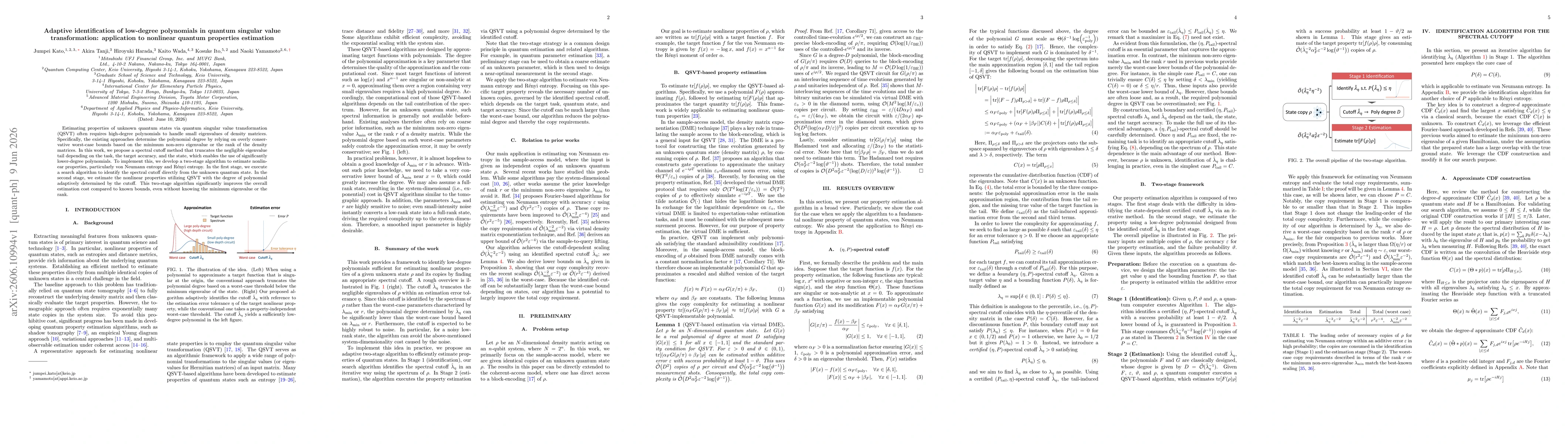
The paper introduces a two-stage algorithm: Stage 1 uses a quantum search procedure to identify a spectral cutoff ˆλ_{η} directly from the unknown state, and Stage 2 applies Quantum Singular Value Transformation (QSVT) with a polynomial degree determined adaptively by this cutoff to estimate nonlinear properties such as von Neumann and Rényi entropies.
SignificanceWhy the work matters
By removing the need for prior knowledge of the minimum eigenvalue or rank, the method reduces circuit depth and resource requirements for quantum property estimation, making QSVT‑based algorithms more practical for near‑term quantum devices.
Technical contributionsWhat the work introduces
Development of a spectral cutoff technique that truncates negligible eigenvalue tails and an associated quantum search algorithm to certify the cutoff, enabling adaptive selection of low-degree polynomials for QSVT‑based nonlinear property estimation.
NoveltyHow it differs from prior work
First work to adaptively determine polynomial degree for QSVT by directly estimating a state‑dependent spectral cutoff, eliminating reliance on conservative worst‑case eigenvalue or rank assumptions.
Discussion 0