Admissible Pairs: A Variation to Pollock Conjectures
Abstract
We introduce a notion of an admissible pair, and prove a variation to Pollock's conjectures on icosahedral and dodecahedral numbers.
Analysis
AI-generated · verify against the original paper
Generated Aug 6, 2026ResultsWhat the authors found
- Defined admissible pairs and essential pairs for polyhedral polynomial representations, extending Pollock-type conjectures to two-polyhedral forms.
- Proved that the set of admissible pairs is upward-closed, enabling reduction to a finite search on minimal pairs.
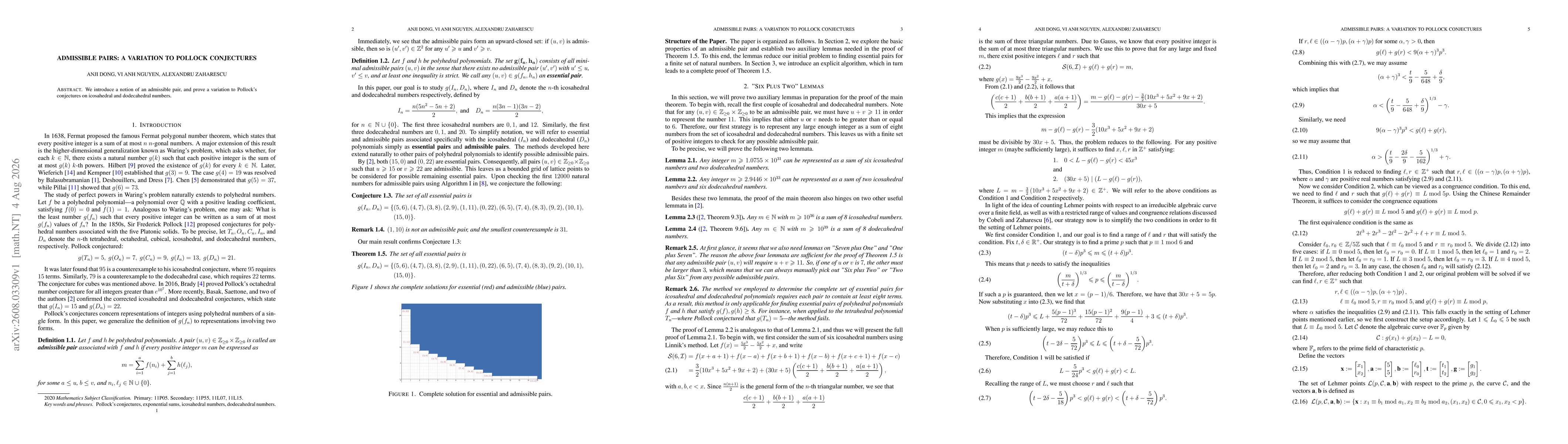
- Identified the complete set of essential pairs for In and Dn: {(5,6),(4,7),(3,8),(2,9),(1,11),(0,22),(6,5),(7,4),(8,3),(9,2),(10,1),(15,0)}.
- Confirmed that certain previously known essential pairs (15,0) and (0,22) remain essential within the two-form generalization, validating consistency with prior Pollock-type results.
LimitationsWhere the findings need caution
- Results are proven for the specific In and Dn polynomials; broader generalization to other polyhedral pairs is left for future work.
- Reliance on algorithmic verification for certain bounds; full theoretical bounding for all potential cases remains to be established.
- The exposition focuses on essential and admissible pairs; practical computation for larger polynomials may require significant resources.
MethodologyHow the work was done
The authors introduce the concept of admissible pairs for pair (f, h) and study g(fn, hn) as the set of minimal admissible pairs. They leverage structural lemmas to demonstrate upward-closedness of admissible pairs and identify essential pairs for In and Dn. The proof strategy combines combinatorial decomposition of representations with algorithmic verification of admissibility for finite candidate pairs, culminating in a full classification of essential pairs for the In, Dn case.
SignificanceWhy the work matters
The work extends Pollock conjectures by allowing two polyhedral polynomials, providing a framework to classify essential representations and offering a pathway to generalized conjectures for multi-form polyhedral sums.
Technical contributionsWhat the work introduces
Introduction of admissible pairs and essential pairs for two polyhedral polynomials, upward-closure property, and exact determination of the essential pair set for Icosahedral and Dodecahedral polynomials, including confirmation of previously known essential pairs in a two-form setting.
NoveltyHow it differs from prior work
First formalization of a two-form generalization of Pollock's conjectures via admissible/essential pairs, and complete classification of essential pairs for In and Dn within this new framework.
Future workQuestions that remain
- Extend the admissible-pair framework to other pairs of polyhedral polynomials beyond In and Dn.
- Develop tighter theoretical bounds to replace computational verification in proving completeness of essential pairs.
- Explore connections with higher-dimensional Pollock-type conjectures and potential new conjectures for multi-form representations.
Discussion 0