Agentic Harness Engineering Beta: Requirement-Centered Evolution of Agent Harnesses
Abstract
Real-world harness engineering is driven by explicit and implicit user requirements, which guide development and validation. However, existing harness evolution methods often overlook implicit requirements and interaction needs, while using a single evolution agent to modify the harness and benchmark scores to select changes. This process often produces narrow patches and leads to benchmark-specific local optima. We introduce Agentic Harness Engineering Beta (AHE-Beta), a requirement-centered loop that brings real-world engineering practices into harness evolution. The loop consists of three steps: (1) User-driven evaluation lets simulated users raise their requirements as issues while they work with the harness over multiple turns. (2) Team-based modification implements those requirements as generalizable changes rather than task-specific patches. (3) Requirement-driven selection merges a change only when it resolves a verified requirement and passes review. Empirically, on held-out tasks, AHE-Beta raises pass@1 from 21.9% to 33.3% while using 40.8% fewer tokens than Base Harness, and achieves higher pass@1 than Claude Code, Meta-Harness, and AHE. In a blind human A/B test, real users prefer AHE-Beta in 31 of 48 valid pairs and rate it higher on all five dimensions, matching the directional preference of the user simulator. The human A/B results show that AHE-Beta achieves its goal of aligning harness evolution with real-world user requirements. Without further evolution, the gains transfer to GLM-5.3 and DeepSeek-V4.1-Flash with pass@1 improvements of 15.8% and 5.3% over Base Harness. Together, these results show that requirement-centered harness evolution is a more general method for improving agent capabilities.
Analysis
AI-generated · verify against the original paper
Generated Jan 1, 0001ResultsWhat the authors found
- Pass@1 improves from 21.9% to 33.3% on held-out tasks while using 40.8% fewer tokens than the Base Harness.
- AHE-Beta achieves higher pass@1 than Claude Code, Meta-Harness, and the original AHE.
- In a blind human A/B test, users prefer AHE-Beta in 31 of 48 valid pairs and rate it higher on all five dimensions.
- Without further evolution, the gains transfer to GLM-5.3 (+15.8% pass@1) and DeepSeek-V4.1-Flash (+5.3% pass@1) over the Base Harness.
MethodologyHow the work was done
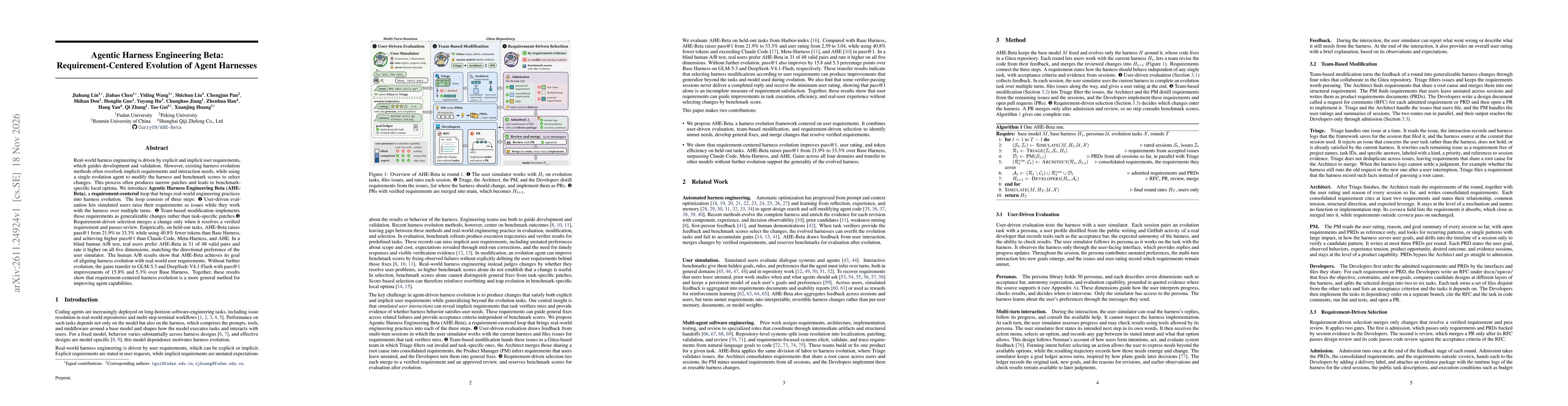
A requirement-centered loop with three steps: (1) User-driven evaluation where simulated users raise requirements as issues over multi-turn interactions; (2) Team-based modification where a team (triage, architect, PM, developers) implements these requirements as generalizable changes; (3) Requirement-driven selection that merges a change only when it resolves a verified requirement and passes review.
SignificanceWhy the work matters
The work demonstrates that aligning harness evolution with explicit and implicit user requirements yields more general and efficient improvements in agent capabilities, reducing overfitting to benchmark-specific optima.
Technical contributionsWhat the work introduces
Introduces a requirement-centered harness evolution framework that integrates user-driven evaluation, team-based modification, and requirement-driven selection, enabling generalizable improvements with lower token consumption.
NoveltyHow it differs from prior work
First to embed real-world engineering practices—explicit and implicit requirement handling and multi-agent team processes—into harness evolution, moving beyond single-agent benchmark-driven patching.
Discussion 0