Abstract
Unmanned Aerial Vehicle Vision-Language Navigation (UAV-VLN) requires agents to follow language instructions, infer spatial structure from sparse multi-view observations, and execute feasible 3D motion in complex outdoor environments. Despite recent progress with large language models, most existing methods still map vision-language inputs directly to actions, providing limited explicit scene grounding and future-aware spatial reasoning. We propose AirForesight, a current-to-future spatial map imagination framework for UAV-VLN. AirForesight first learns a structured current-map representation from multi-view observations. This representation is jointly supervised by current-map reconstruction and future-trajectory prediction, encouraging it to encode both present scene structure and future motion intent. Under structured causal attention, the current spatial knowledge is propagated to future-map reasoning, and the resulting current and future representations are aggregated to predict the next 3D waypoint. To make spatial imagination more relevant to navigation, we introduce a cross-space planning consistency loss that encourages directional agreement between the predicted map-space trajectory and the expert action direction derived from the ground-truth waypoint displacement. Experiments on OpenUAV and AerialVLN-S, together with extensive ablations, demonstrate strong performance and support the effectiveness and stability of the proposed framework.
Analysis
AI-generated · verify against the original paper
Generated Aug 15, 2026ResultsWhat the authors found
- On OpenUAV test split, AirForesight improves SR from 30.47% to 35.83% and SPL from 25.37% to 30.22%, while reducing NE from 68.44m to 56.99m over Travel UAV baselines.
- On AerialVLN-S, the method demonstrates strong performance and stability across multiple seeds and ablations, supporting the efficacy of the proposed framework.
- Extensive ablations show that jointly modeling current-map reconstruction and future-trajectory prediction, plus cross-space consistency loss, yields improved waypoint accuracy and navigation reliability.
LimitationsWhere the findings need caution
- Experiments are reported on benchmark splits OpenUAV and AerialVLN-S; real-world deployment under varied weather and sensor noise is not exhaustively evaluated.
- The approach introduces additional pretraining signals (current-map reconstruction and future-trajectory prediction) that may increase training complexity and data requirements.
MethodologyHow the work was done
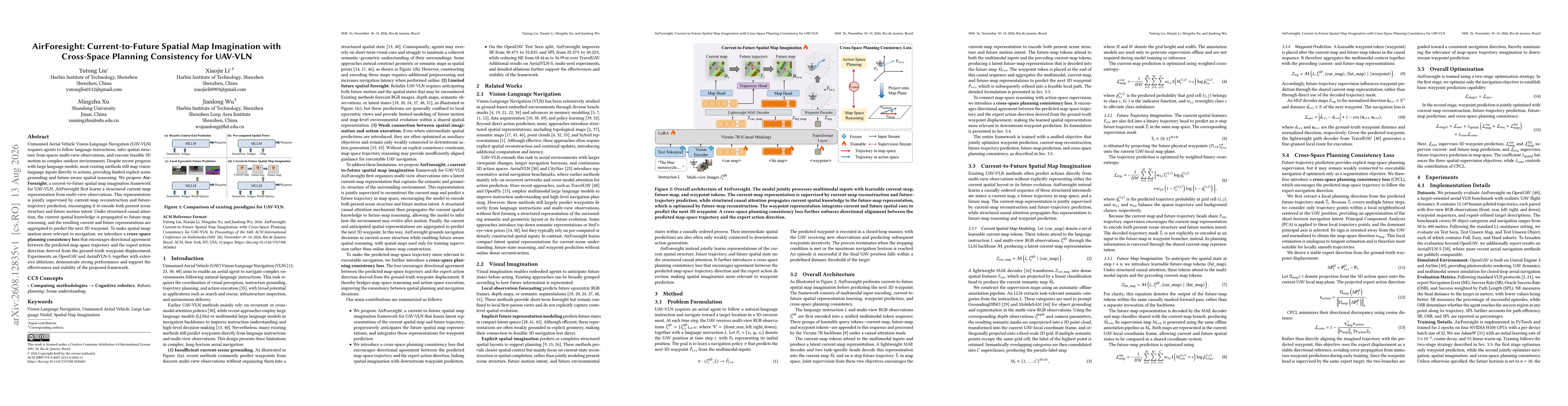
AirForesight introduces a current-to-future spatial map imagination framework that learns a structured current-map from multi-view UAV observations, jointly supervising current-map reconstruction and future-trajectory prediction. A structured causal attention mechanism propagates current spatial knowledge into future-map reasoning, and current and future representations are fused to predict the next 3D waypoint. A cross-space planning consistency loss aligns the predicted map-space trajectory with the expert action direction derived from ground-truth waypoint displacement to bridge spatial imagination with action execution.
SignificanceWhy the work matters
The work bridges spatial imagination and action through an explicit current-to-future map representation and a cross-space consistency objective, enabling more reliable long-horizon UAV-VLN navigation with explicit scene grounding and future-aware planning.
Technical contributionsWhat the work introduces
A novel current-to-future spatial map imagination framework for UAV-VLN that (i) learns a structured current-map representation and future trajectory in map-space, (ii) uses structured causal attention to propagate current spatial knowledge to future reasoning, and (iii) introduces a cross-space planning consistency loss to align map-space trajectories with action directions, improving alignment between spatial imagination and waypoint execution.
NoveltyHow it differs from prior work
First to jointly optimize current-map reconstruction and future-trajectory prediction within a single latent spatial map, incorporate structured causal attention for cross-time reasoning, and enforce cross-space consistency between map-space trajectories and action directions in UAV-VLN.
Future workQuestions that remain
- Extend AirForesight to handle more diverse weather conditions and sensor modalities to enhance robustness in real-world UAV operations.
- Investigate light-weight architectures or distillation to reduce computation for online deployment without sacrificing spatial imagination quality.
- Explore transfer to other embodied navigation tasks with cross-space planning consistency under different modalities.
Discussion 0