All-dielectric high-Q dynamically tunable transmissive metasurfaces
This paper presents all-dielectric active metasurfaces utilizing amorphous silicon pillars on a silica substrate to dynamically manipulate transmitted light wavefronts with high quality factors. The metasurfaces enable rapid thermo-optic beam switching and steering with low refractive index variations, demonstrating potential for compact, integrated optical devices.
Abstract
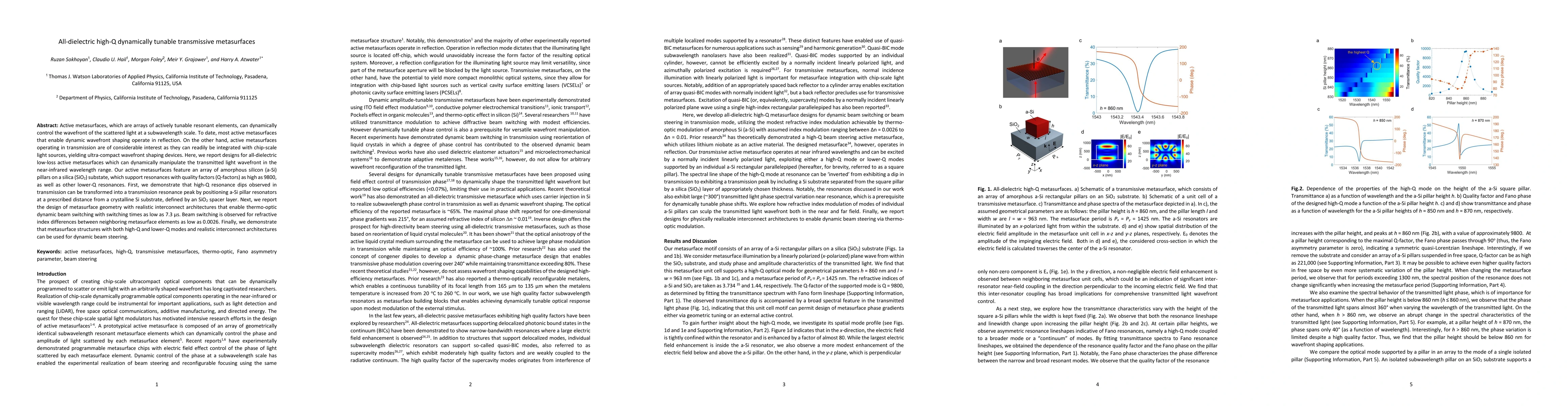
Active metasurfaces, which are arrays of actively tunable resonant elements, can dynamically control the wavefront of the scattered light at a subwavelength scale. To date, most active metasurfaces that enable dynamic wavefront shaping operate in reflection. On the other hand, active metasurfaces operating in transmission are of considerable interest as they can readily be integrated with chip-scale light sources, yielding ultra-compact wavefront shaping devices. Here, we report designs for all-dielectric low-loss active metasurfaces which can dynamically manipulate the transmitted light wavefront in the near-infrared wavelength range. Our active metasurfaces feature an array of amorphous silicon (a-Si) pillars on a silica substate, which support resonances with quality factors (Q-factors) as high as 9800, as well as other lower-Q resonances. First, we demonstrate that high-Q resonance dips observed in transmission can be transformed into a transmission resonance peak by positioning a-Si pillar resonators at a prescribed distance from a crystalline Si substrate, defined by a silica spacer layer. Next, we report the design of metasurface geometry with realistic interconnect architectures that enable thermo-optic dynamic beam switching with switching times as low as 7.3 {\mu}s. Beam switching is observed for refractive index differences between neighboring metasurface elements as low as 0.0026. Finally, we demonstrate that metasurface structures with both high-Q and lower-Q modes and realistic interconnect architectures can be used for dynamic beam steering.
AI Key Findings
Get AI-generated insights about this paper's methodology, results, significance, and more — available when analysis has been generated.
Discussion 0