Allocation Tracking and Parameter Checking for Parallel Programming Models using Contracts
Abstract
Correctness checking tools for High-Performance Computing programs are typically limited to specific parallel programming models such as MPI or OpenSHMEM. The CoVer framework previously addressed this by introducing a generic, contract-based approach that decoupled API requirements from the core tool. However, CoVer's effectiveness remains bounded by the expressiveness of its underlying contract language, restricting the types of errors it can verify. This paper presents an extension to the CoVer contract language designed to capture and check a broader range of error classes. Our extensions introduce generic parameter checking and allocation tracking, while keeping generality across both programming model and language. We evaluate these extensions and demonstrate that analysis accuracy remains consistent across multiple languages, reinforcing the framework's general applicability. While the additional runtime analyses naturally incur a performance overhead, these improvements greatly enhance CoVer's utility with a significant accuracy improvement.
Analysis
AI-generated · verify against the original paper
Generated Aug 4, 2026ResultsWhat the authors found
- The extended contract language enables static and dynamic checking of parameter correctness and allocation tracking, increasing error coverage beyond prior limitations.
- Analysis accuracy remains consistent across multiple programming languages, supporting the framework's general applicability to different HPC languages.
- Runtime analyses incur performance overhead but yield significant improvements in detection accuracy for allocation and parameter-related errors.
LimitationsWhere the findings need caution
- Runtime overhead introduced by the additional analyses may impact performance-critical HPC workloads.
- Some error classes may still be constrained by the expressiveness of the contract language in edge cases not captured by the new constructs.
MethodologyHow the work was done
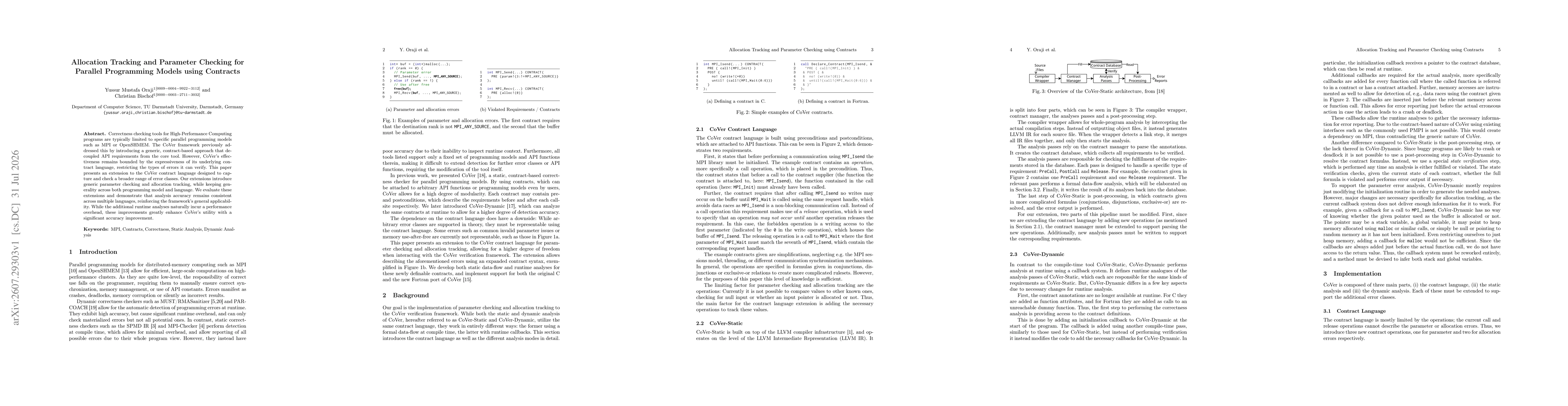
The paper extends the CoVer contract language to support parameter checking and allocation tracking, implementing both static data-flow analysis (CoVer-Static) and runtime analysis (CoVer-Dynamic). It describes the integration of new contract constructs (e.g., alloc! and param! constraints) for multi-language applicability (C, Fortran), and evaluates accuracy and performance overhead across multiple languages through static and dynamic analyses within the CoVer framework.
SignificanceWhy the work matters
Demonstrates a broader, language-agnostic verification capability for parallel programming models, improving correctness checking in HPC environments by integrating allocation tracking with parameter validation and maintaining modularity via contracts.
Technical contributionsWhat the work introduces
An extended CoVer contract language enabling generic parameter checking and allocation tracking, with static data-flow and runtime analyses, demonstrated across multiple languages while preserving framework generality.
NoveltyHow it differs from prior work
Introduces novel contract constructs for parameter validation and allocation tracking within CoVer, expanding error coverage and enabling cross-language applicability in correctness checking for parallel programming models.
Future workQuestions that remain
- Extend support to more programming languages and APIs beyond MPI/Fortran to broaden applicability.
- Optimize the runtime analysis to reduce overhead while preserving detection accuracy.
- Explore additional contract primitives to cover further error classes not representable previously.
Discussion 0