Ambient unitaries don't enable shallow group designs
Abstract
Characterising the efficiency with which designs over various subsets of the unitary group may be constructed is an important goal of quantum information theory. While it is now known that approximate unitary designs can be realised in depth logarithmic in the system size, it has recently been shown that ensembles of local nearest-neighbour sublinear-depth one-dimensional circuits over the matchgate, orthogonal, and symplectic groups cannot form approximate 2-designs over their parent groups; similarly, sublinear-depth ensembles of Cliffords cannot form a Clifford 4-design. In this note we show that this remarkable exponential separation is not merely an artefact of restricting to ensembles consisting of unitaries from the subgroups themselves, but rather that no ensemble of local nearest-neighbour sublinear-depth unitaries can realise approximate designs in the aforementioned cases, even when employing "ambient" unitaries from beyond the subgroup itself (possibly acting on ancilla qubits). This implies that various natural tomography and benchmarking schemes which involves sampling from these groups suffer from a dramatic circuit depth overhead compared to similar protocols which involve sampling from the full unitary group. We additionally conclude that, in all of the above cases, the known linear-depth design constructions are up to constant factors optimal.
Analysis
AI-generated · verify against the original paper
Generated Aug 15, 2026ResultsWhat the authors found
- Ambient unitaries do not enable shallow designs: even with non-subgroup or ancilla-assisted unitaries, sublinear-depth local circuits fail to form approximate 2-designs (or Clifford 4-designs) for the specified groups.
- Exponential separation persists beyond subgroup-restricted ensembles: the impossibility results hold when allowing ambient unitaries, not just unitaries from the subgroup itself.
- Linear-depth constructions remain near-optimal: for these groups, known linear-depth design constructions are optimal up to constant factors.
LimitationsWhere the findings need caution
- Results are restricted to local nearest-neighbour sublinear-depth unitaries and the specific groups considered (matchgate, orthogonal, symplectic, Clifford).
- The analysis focuses on asymptotic depth lower bounds and does not quantify exact constants for all architectures.
- Empirical validation on experimental platforms is not provided; conclusions are theoretical.
MethodologyHow the work was done
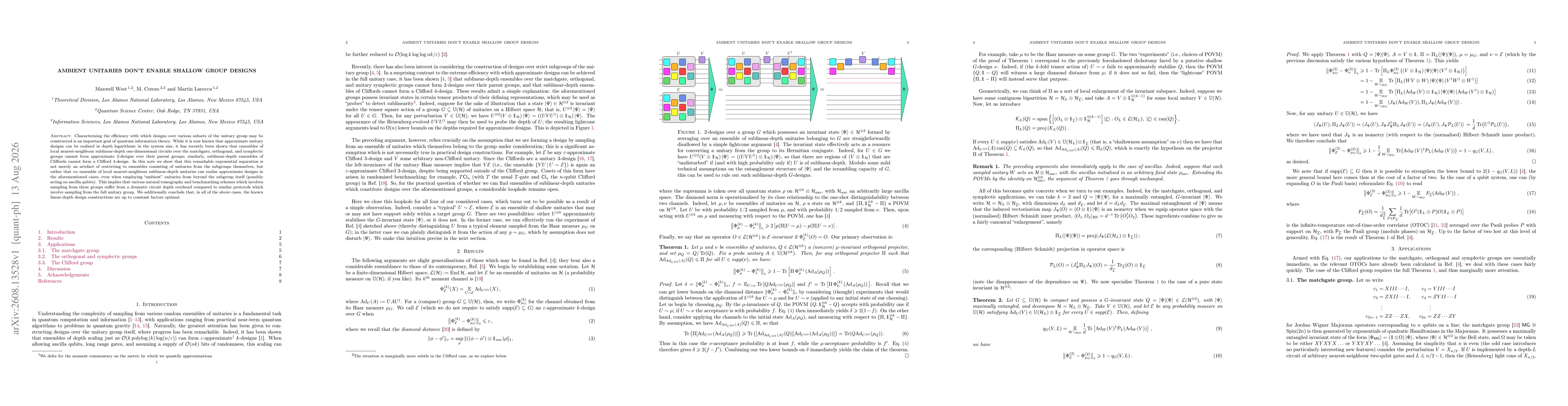
The study presents a general argument showing that no ensemble of local nearest-neighbour sublinear-depth unitaries can realize approximate designs over certain subgroups (matchgate, orthogonal, symplectic, Clifford) even when supplemented with ambient unitaries acting on ancillas. The authors define ε-approximate k-designs via moments Φ(k) and compare to Haar-derived channels Φ(k)µG, then demonstrate that perturbations sampled from outside the subgroup fail to disturb invariant states in a way that would permit shallow designs, thereby establishing lower bounds on circuit depth needed for such designs.
SignificanceWhy the work matters
This work closes a loophole by showing that ambient unitaries cannot overcome depth barriers for achieving approximate designs in several important groups, implying that tomography and benchmarking schemes using these groups face unavoidable circuit-depth overheads compared to full unitary designs.
Technical contributionsWhat the work introduces
Provision of a general framework showing that ambient unitaries cannot realize approximate designs with sublinear-depth local circuits for several important unitary groups, thereby generalizing prior subgroup-only no-go results and establishing depth-optimality of linear-depth design constructions up to constants.
NoveltyHow it differs from prior work
Introduces a loophole-closing argument demonstrating that allowing ambient unitaries (potentially acting on ancillas) does not enable shallow designs for matchgate, orthogonal, symplectic, and Clifford groups, extending previous subgroups-only results to a broader, practically relevant setting.
Future workQuestions that remain
- Extend the ambient-unitary impossibility results to other groups and circuit architectures beyond the ones studied.
- Investigate potential alternative design notions or benchmarks that may circumvent depth limitations for practical tomography.
- Develop explicit constructions or proofs quantifying the exact constants in the linear-depth optimality for these groups.
- Explore numerical simulations to illustrate the depth overhead in realistic noisy settings.
Discussion 0