Amplitude modulation and surface wave generation in a complex plasma monolayer
This paper explores the response of a two-dimensional plasma crystal to an external perturbation using molecular dynamics simulations, revealing amplitude modulation and the generation of concentric circular surface waves through parametric decay and beat motions. The study also discusses the dispersion relation of the observed transverse shear surface waves.
Abstract
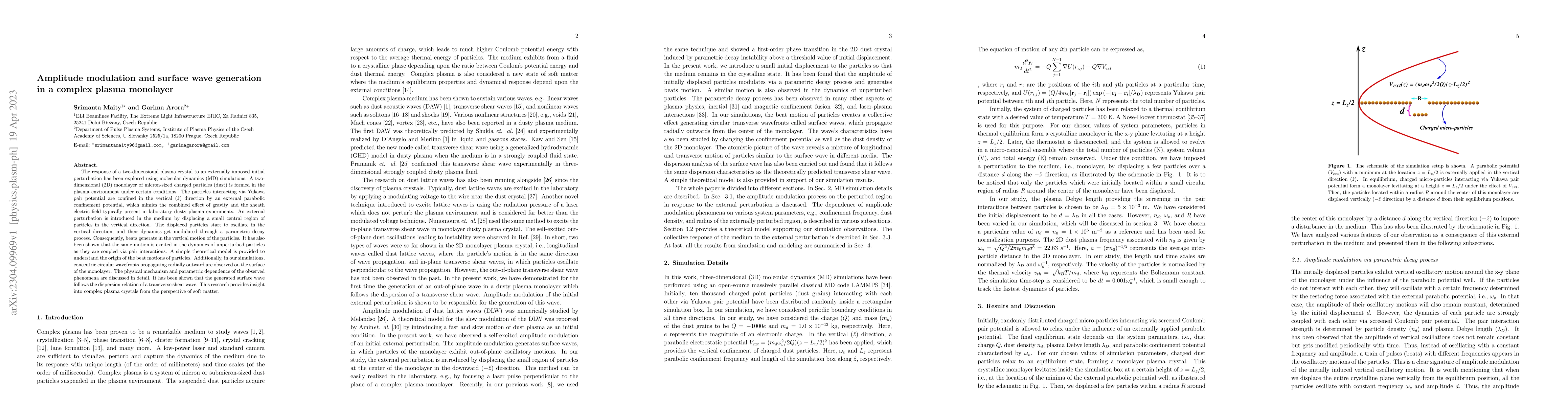
The response of a two-dimensional plasma crystal to an externally imposed initial perturbation has been explored using molecular dynamics (MD) simulations. A two-dimensional (2D) monolayer of micron-sized charged particles (dust) is formed in the plasma environment under certain conditions. The particles interacting via Yukawa pair potential are confined in the vertical ($\hat z$) direction by an external parabolic confinement potential, which mimics the combined effect of gravity and the sheath electric field typically present in laboratory dusty plasma experiments. An external perturbation is introduced in the medium by displacing a small central region of particles in the vertical direction. The displaced particles start to oscillate in the vertical direction, and their dynamics get modulated through a parametric decay process. Consequently, beats generate in the vertical motion of the particles. It has also been shown that the same motion is excited in the dynamics of unperturbed particles as they are coupled via pair interactions. A simple theoretical model is provided to understand the origin of the beat motions of particles. Additionally, in our simulations, concentric circular wavefronts propagating radially outward are observed on the surface of the monolayer. The physical mechanism and parametric dependence of the observed phenomena are discussed in detail. It has been shown that the generated surface wave follows the dispersion relation of a transverse shear wave. This research provides insight into complex plasma crystals from the perspective of soft matter.
AI Key Findings
Get AI-generated insights about this paper's methodology, results, significance, and more — available when analysis has been generated.
Discussion 0