An Asymptotic Orthogonality Relation for ${\rm GL}(n, \mathbb R)$
This research extends asymptotic orthogonality relations for the general linear group ${\rm GL}(n, \mathbb R)$ to all $n \geq 2$, providing a new result for $n=5$ based on the Kim-Shahidi theorem. For $n > 5$, results rely on conjectures about Rankin-Selberg L-functions and recurrence relations for Mellin transforms, with a proof technique involving the Kuznetsov Trace formula and analysis of various cusp forms and series.
Abstract
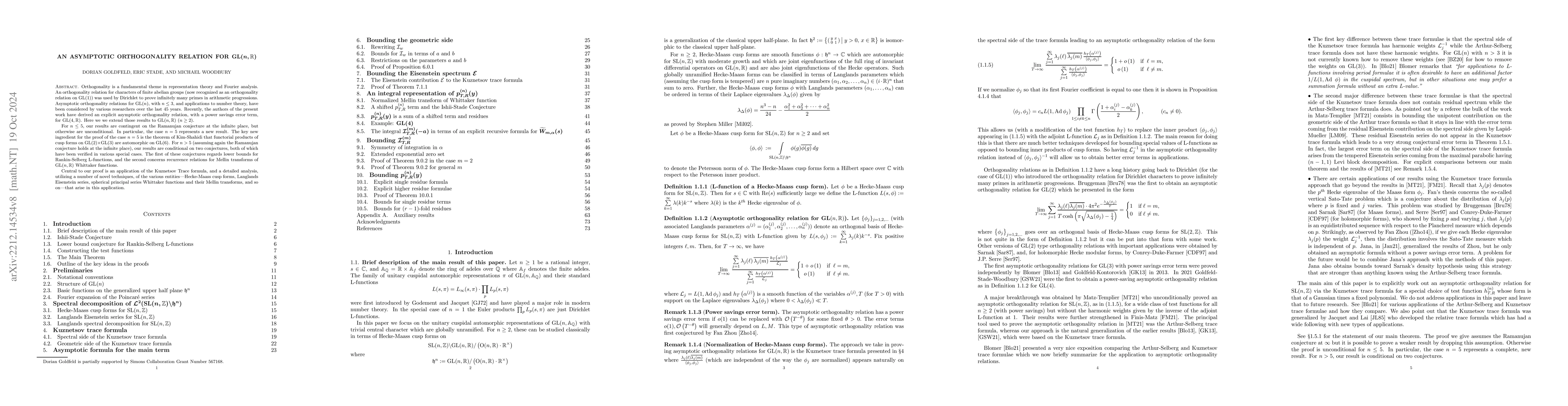
Orthogonality is a fundamental theme in representation theory and Fourier analysis. An orthogonality relation for characters of finite abelian groups (now recognized as an orthogonality relation on GL(1)) was used by Dirichlet to prove infinitely many primes in arithmetic progressions. Asymptotic orthogonality relations for GL$(n)$, with $n\le 3$, and applications to number theory, have been considered by various researchers over the last 45 years. Recently, the authors of the present work have derived an explicit asymptotic orthogonality relation, with a power savings error term, for GL$(4,\mathbb R)$. Here we we extend those results to GL$(n,\mathbb R)$ $(n\ge2)$. For $n\le 5$ our results are unconditional. In particular, the case $n=5$ represents a new result. The key new ingredient for the proof of the case $n=5$ is the theorem of Kim-Shahidi that functorial products of cusp forms on GL(2)$\times$GL(3) are automorphic on GL(6). For $n>5$ our results are conditional on two conjectures, both of which have been verified in various special cases. The first of these conjectures regards lower bounds for Rankin-Selberg L-functions, and the second concerns recurrence relations for Mellin transforms of GL$(n,\mathbb R)$ Whittaker functions. Our methods assume the Ramanujan conjecture at the infinite place for Maass cusp forms, but this assumption can be removed with a weakening in our error term. Central to our proof is an application of the Kuznetsov Trace formula, and a detailed analysis, utilizing a number of novel techniques, of the various entities -- Hecke-Maass cusp forms, Langlands Eisenstein series, spherical principal series Whittaker functions and their Mellin transforms, and so on -- that arise in this application.
AI Key Findings
Get AI-generated insights about this paper's methodology, results, significance, and more — available when analysis has been generated.
Discussion 0