An Integrated Architecture for Data-Efficient Real-Time Neural Imitation of Nonlinear Time-Optimal Model Predictive Control
Abstract
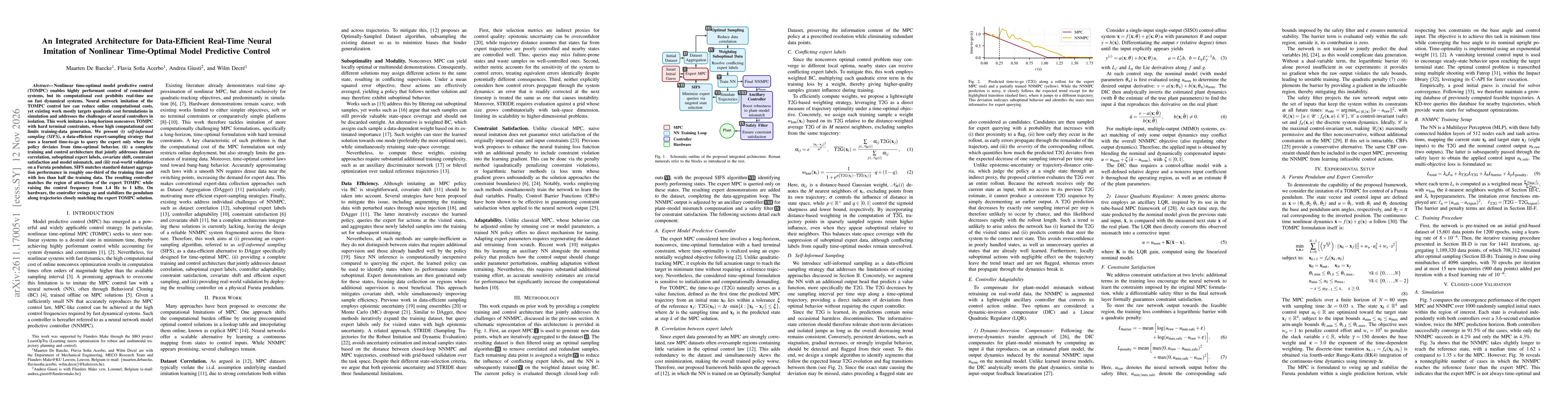
Nonlinear time-optimal model predictive control (TOMPC) enables highly performant control of constrained systems, but its computational cost prohibits real-time use on fast dynamical systems. Neural network imitation of the TOMPC control law can reduce online computational costs, yet existing work mostly targets quadratic cost formulations in simulation and addresses the challenges of neural controllers in isolation. This work imitates a long-horizon nonconvex TOMPC with hard terminal constraints, whose high computational cost limits training-data generation. We present (i) \emph{self-informed sampling (SIFS)}, a data-efficient expert-sampling strategy that uses a learned time-to-go to query the expert only where the policy deviates from time-optimal behavior, (ii) a complete training and control architecture that jointly addresses dataset correlation, suboptimal expert labels, covariate shift, constraint satisfaction and model mismatch, and (iii) real-world validation on a Furuta pendulum. SIFS matches standard dataset aggregation performance in roughly one-third of the training time and with less than half the training data. The resulting controller matches the region of attraction of the expert TOMPC while raising the control frequency from 1.4~Hz to 1~kHz. On hardware, the controller swings up and stabilizes the pendulum along trajectories closely matching the expert TOMPC solution.
Analysis
AI-generated · verify against the original paper
Generated Jan 1, 0001ResultsWhat the authors found
- SIFS achieves comparable performance to standard DAgger while using roughly one‑third of the training time and less than half the training data.
- The resulting neural MPC matches the region of attraction of the expert TOMPC and raises the control frequency from 1.4 Hz to up to 1 kHz (CPU ~100 Hz, GPU <1 ms inference).
- On a physical Furuta pendulum, the NN‑MPC swings up and stabilizes the pendulum with trajectories closely matching the expert solution, despite sensor noise and residual model mismatch.
- GPU implementation yields a >700‑fold reduction in worst‑case computation time compared to the original MPC.
LimitationsWhere the findings need caution
- Performance gaps on hardware are attributed to sensor noise and residual plant‑model mismatch, indicating sensitivity to measurement errors.
- The authors note that insufficient training data or suboptimal handling of conflicting expert labels can affect convergence times.
MethodologyHow the work was done
The paper introduces a self‑informed sampling (SIFS) strategy that uses a learned time‑to‑go model to query the expert only where the policy deviates from time‑optimal behavior, a weighting scheme based on T2G to handle conflicting expert labels, and an integrated training and control architecture that addresses dataset correlation, suboptimal expert labels, covariate shift, constraint satisfaction, and model mismatch. The architecture also incorporates lightweight ancillary controllers (LQR and DIC) to improve robustness to plant‑model mismatch without retraining.
SignificanceWhy the work matters
By enabling data‑efficient imitation of a computationally intensive time‑optimal MPC with hard terminal constraints, the work makes real‑time optimal control feasible for fast, constrained systems, bridging the gap between high‑performance model‑based control and practical hardware deployment.
Technical contributionsWhat the work introduces
An integrated architecture that combines self‑informed expert sampling, T2G‑based label weighting, and ancillary controllers to deliver a data‑efficient, real‑time neural imitation of nonlinear time‑optimal MPC with hard constraints.
NoveltyHow it differs from prior work
First demonstration of a data‑efficient sampling strategy specifically tailored for long‑horizon, nonconvex time‑optimal MPC with hard terminal constraints, integrated with solutions for dataset correlation, constraint satisfaction, and model mismatch, validated on real hardware.
Future workQuestions that remain
- Explore multimodal architectures such as Mixture Density Networks to better capture multiple optimal solutions.
- Investigate continual learning approaches to limit training‑time growth as the dataset expands.
Discussion 0