Anomalous valley Hall effect in antiferromagnetic monolayers
This research proposes a novel method to realize the anomalous valley Hall effect in antiferromagnetic monolayers by using nonequilibrium potentials to break PT symmetry, demonstrated through first-principles calculations on MnPSe3 stacked on Sc2CO2. The effect can be controlled and switched on or off via an electric field, providing a new direction for condensed-matter physics studies.
Abstract
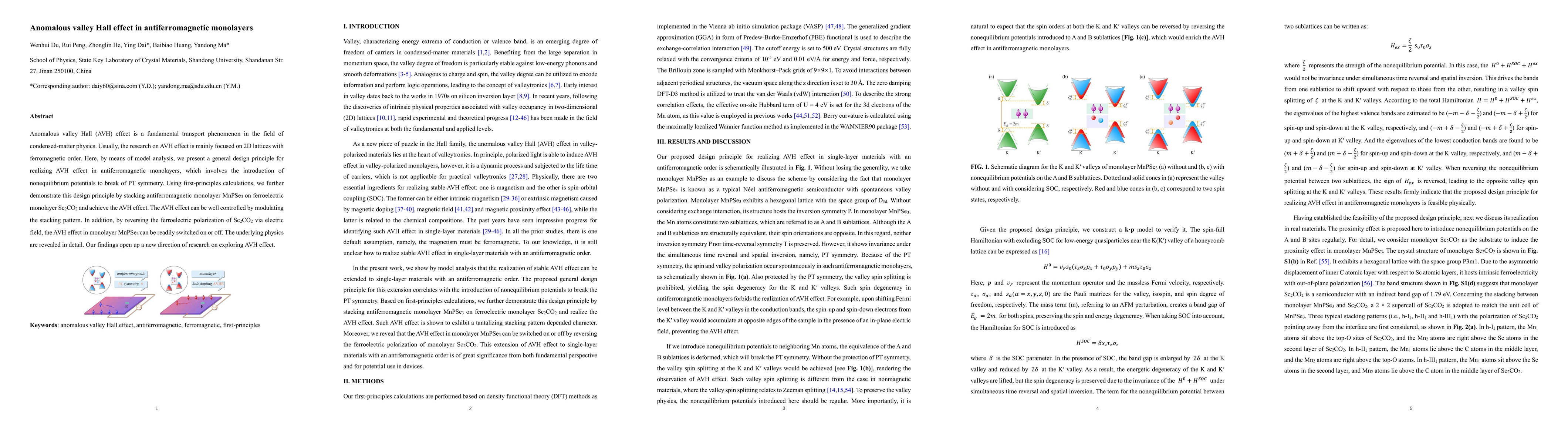
Anomalous valley Hall (AVH) effect is a fundamental transport phenomenon in the field of condensed-matter physics. Usually, the research on AVH effect is mainly focused on 2D lattices with ferromagnetic order. Here, by means of model analysis, we present a general design principle for realizing AVH effect in antiferromagnetic monolayers, which involves the introduction of nonequilibrium potentials to break of PT symmetry. Using first-principles calculations, we further demonstrate this design principle by stacking antiferromagnetic monolayer MnPSe3 on ferroelectric monolayer Sc2CO2 and achieve the AVH effect. The AVH effect can be well controlled by modulating the stacking pattern. In addition, by reversing the ferroelectric polarization of Sc2CO2 via electric field, the AVH effect in monolayer MnPSe3 can be readily switched on or off. The underlying physics are revealed in detail. Our findings open up a new direction of research on exploring AVH effect.
AI Key Findings
Get AI-generated insights about this paper's methodology, results, significance, and more — available when analysis has been generated.
Discussion 0