Antihydrogen Formation, Trapping and Dynamics
This paper details the ALPHA experiment's efforts to produce and trap cold antihydrogen atoms, addressing the challenge of confining them in a magnetic trap due to the disparity between trap depth and plasma energies. It presents techniques for antihydrogen production, analyzes annihilation distributions, and reports successful confinement of antihydrogen atoms.
Abstract
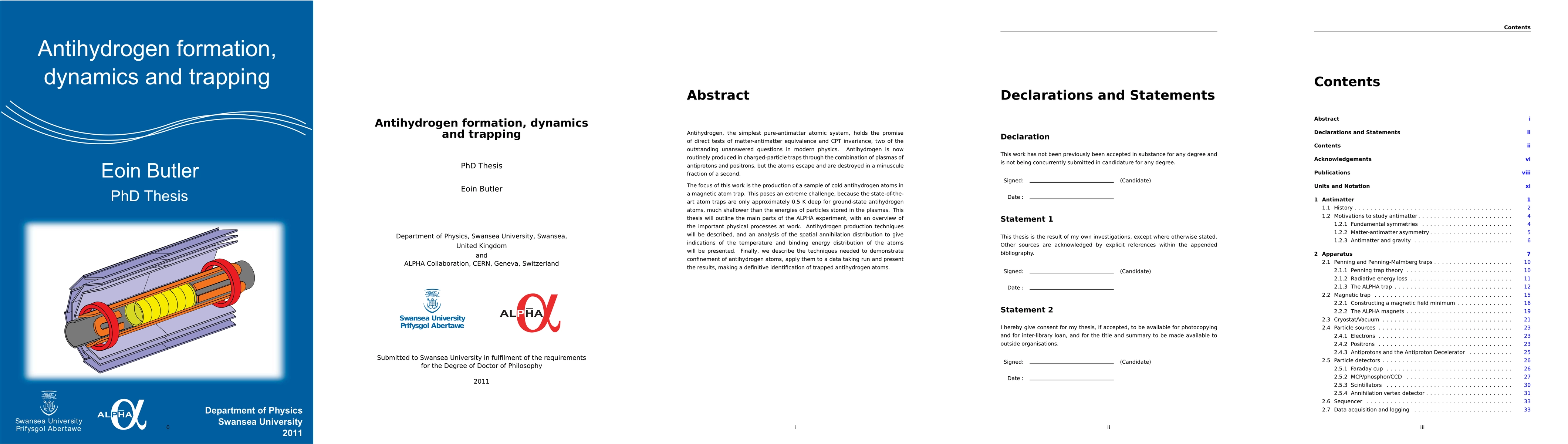
Antihydrogen, the simplest pure-antimatter atomic system, holds the promise of direct tests of matter-antimatter equivalence and CPT invariance, two of the outstanding unanswered questions in modern physics. Antihydrogen is now routinely produced in charged-particle traps through the combination of plasmas of antiprotons and positrons, but the atoms escape and are destroyed in a minuscule fraction of a second. The focus of this work is the production of a sample of cold antihydrogen atoms in a magnetic atom trap. This poses an extreme challenge, because the state-of-the-art atom traps are only approximately 0.5 K deep for ground-state antihydrogen atoms, much shallower than the energies of particles stored in the plasmas. This thesis will outline the main parts of the ALPHA experiment, with an overview of the important physical processes at work. Antihydrogen production techniques will be described, and an analysis of the spatial annihilation distribution to give indications of the temperature and binding energy distribution of the atoms will be presented. Finally, we describe the techniques needed to demonstrate confinement of antihydrogen atoms, apply them to a data taking run and present the results, making a definitive identification of trapped antihydrogen atoms.
AI Key Findings
Get AI-generated insights about this paper's methodology, results, significance, and more — available when analysis has been generated.
Discussion 0