Area correlations related to lattice points in discs
The paper studies how areas formed by lattice points near circles behave as the circle grows, using circle flows on a torus to model a charged particle's motion. They find that, unlike expected in simple integrable systems, the area measurements exhibit mixing (random-like behavior) and they derive the full probability distribution of these areas, both globally and in smaller scales.
Abstract
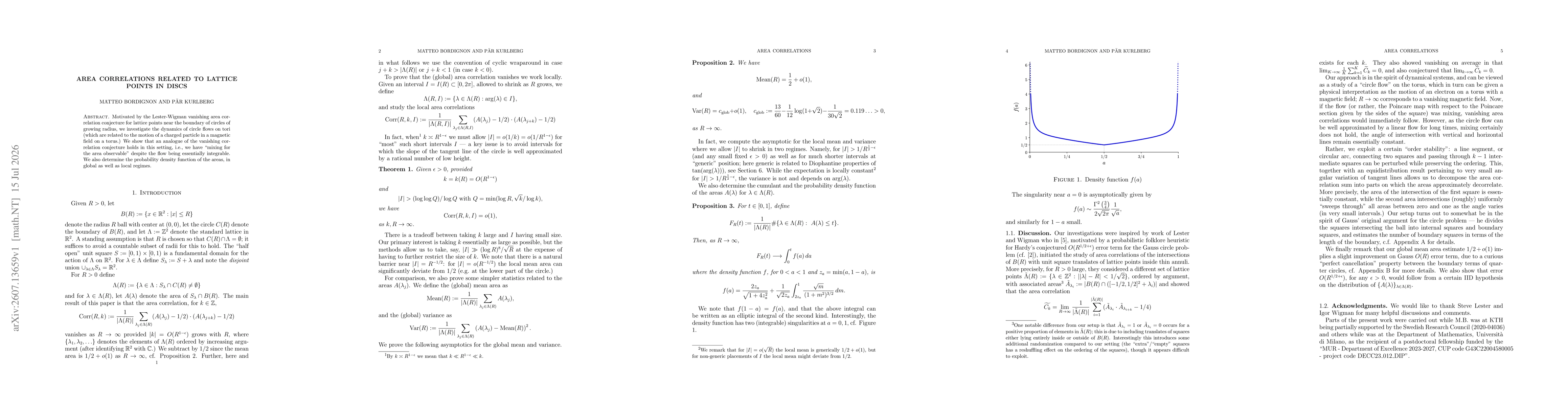
Motivated by the Lester-Wigman vanishing area correlation conjecture for lattice points near the boundary of circles of growing radius, we investigate the dynamics of circle flows on tori (which are related to the motion of a charged particle in a magnetic field on a torus.) We show that an analogue of the vanishing correlation conjecture holds in this setting, i.e., we have "mixing for the area observable" despite the flow being essentially integrable. We also determine the probability density function of the areas, in global as well as local regimes.
Analysis
AI-generated · verify against the original paper
Generated Jul 17, 2026ResultsWhat the authors found
- The area correlation Corr(R,k) vanishes as R → ∞ for k = O(R1−ε), establishing a mixing-type phenomenon for the area observable in essentially integrable circle flows on the torus.
- Global mean and variance of the area A(λ) satisfy asymptotics: Mean(R) and Var(R) demonstrate leading-order behavior with respect to the circle radius R, including improvement terms linked to boundary contributions.
- Local correlations Corr(R,k,I) exhibit vanishing behavior under appropriate shrinking intervals I with size constraints, revealing local mixing phenomena despite integrability.
LimitationsWhere the findings need caution
- Results rely on asymptotic regimes in R with specific growth rates for k and interval size I, leaving exact finite-R behavior less understood.
- Dependence on boundary term cancellations suggests potential sensitivity to lattice geometry and choice of fundamental domain, which may limit generalization to other settings.
- Local results require careful avoidance of rationals approximating tangents; there may be exceptional intervals where standard assumptions fail.
MethodologyHow the work was done
The authors study circle flows on tori and analyze area observables associated with lattice shifts; they define global and local area correlations Corr(R,k) and use averaging over lattice translates λ in Λ(R) to establish vanishing correlations as R grows, employing local-to-global analysis and cyclic wraparound to handle boundary terms.
SignificanceWhy the work matters
Demonstrates an analogue of the Lester-Wigman vanishing area correlation conjecture in circle-flow dynamics on tori, showing mixing for a geometric observable (area) in an essentially integrable system and providing a probabilistic description of area distributions globally and locally.
Technical contributionsWhat the work introduces
Introduces global and local area-correlation statistics for circle flows on tori, proves vanishing correlations for k in a broad growth range, and analyzes the probability density of areas both globally and locally, connecting geometric area observables with lattice-point counting techniques and boundary term cancellations.
NoveltyHow it differs from prior work
Presents the first result showing mixing-type behavior for the area observable in an essentially integrable dynamical system on the torus, together with a detailed distributional analysis of areas and a nuanced treatment of boundary-induced cancellations.
Future workQuestions that remain
- Extend the framework to higher-dimensional analogues, studying area-volume observables in toral flows with more complex boundary geometries.
- Investigate quantitative rates for convergence in Corr(R,k) and higher moments of A(λ) beyond mean and variance.
- Explore robustness under perturbations of the flow or lattice, including quasi-periodic or nonlattice settings and random perturbations.
Discussion 0