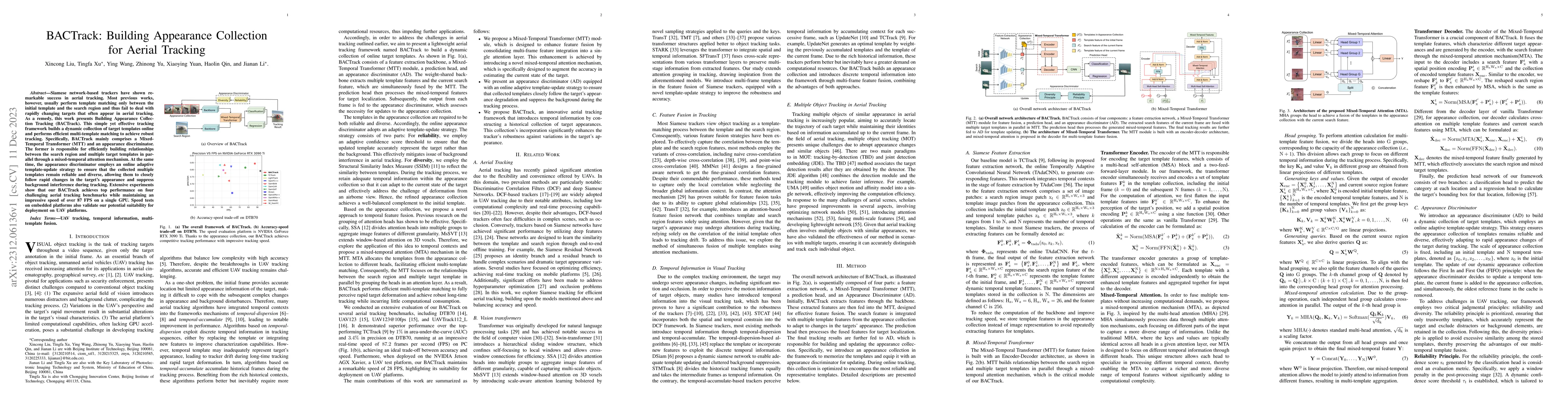
BACTrack introduces a dynamic collection of target templates for robust aerial tracking using a Mixed-Temporal Transformer and an appearance discriminator, achieving top performance on multiple benchmarks while maintaining high speed suitable for UAV deployment.
Abstract
Siamese network-based trackers have shown remarkable success in aerial tracking. Most previous works, however, usually perform template matching only between the initial template and the search region and thus fail to deal with rapidly changing targets that often appear in aerial tracking. As a remedy, this work presents Building Appearance Collection Tracking (BACTrack). This simple yet effective tracking framework builds a dynamic collection of target templates online and performs efficient multi-template matching to achieve robust tracking. Specifically, BACTrack mainly comprises a Mixed-Temporal Transformer (MTT) and an appearance discriminator. The former is responsible for efficiently building relationships between the search region and multiple target templates in parallel through a mixed-temporal attention mechanism. At the same time, the appearance discriminator employs an online adaptive template-update strategy to ensure that the collected multiple templates remain reliable and diverse, allowing them to closely follow rapid changes in the target's appearance and suppress background interference during tracking. Extensive experiments show that our BACTrack achieves top performance on four challenging aerial tracking benchmarks while maintaining an impressive speed of over 87 FPS on a single GPU. Speed tests on embedded platforms also validate our potential suitability for deployment on UAV platforms.
AI Key Findings
Get AI-generated insights about this paper's methodology, results, significance, and more — available when analysis has been generated.
Discussion 0