BayesPath: Reliability-Aware Bayesian Reasoning for Whole-Slide Pathology Agents
Abstract
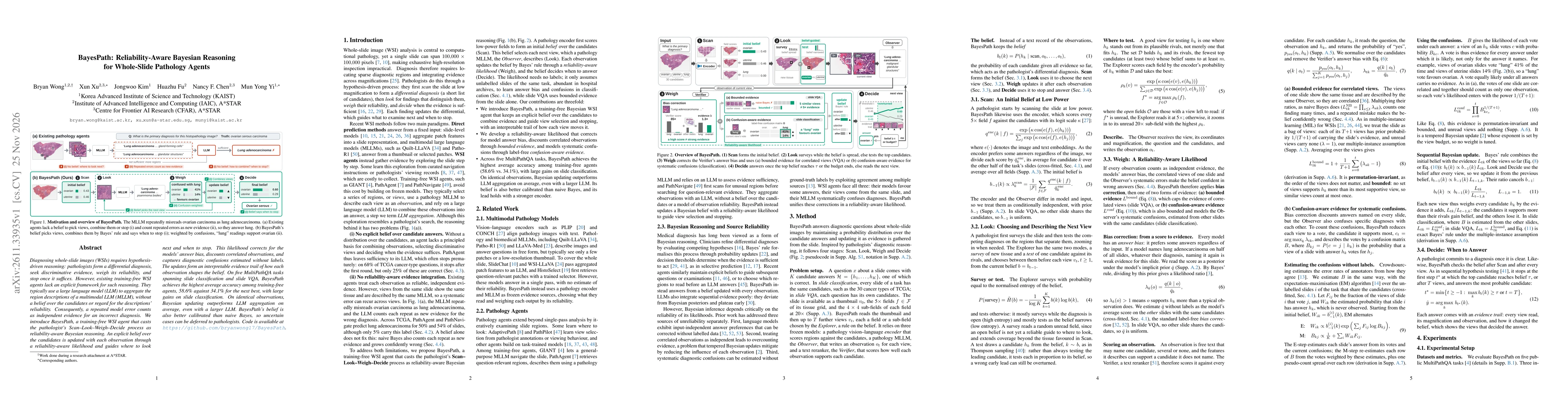
Diagnosing whole-slide images (WSIs) requires hypothesis-driven reasoning: pathologists form a differential diagnosis, seek discriminative evidence, weigh its reliability, and stop once it suffices. However, existing training-free WSI agents lack an explicit framework for such reasoning. They typically use a large language model (LLM) to aggregate the region descriptions of a multimodal LLM (MLLM), without a belief over the candidates or regard for the descriptions' reliability. Consequently, a repeated model error counts as independent evidence for an incorrect diagnosis. We introduce BayesPath, a training-free WSI agent that casts the pathologist's Scan-Look-Weigh-Decide process as reliability-aware Bayesian reasoning. An explicit belief over the candidates is updated with each observation through a reliability-aware likelihood and guides where to look next and when to stop. This likelihood corrects for the models' answer bias, discounts correlated observations, and captures diagnostic confusions estimated without labels. The updates form an interpretable evidence trail of how each observation shapes the belief. On five MultiPathQA tasks spanning slide classification and slide VQA, BayesPath achieves the highest average accuracy among training-free agents, 58.6% against 34.1% for the next best, with large gains on slide classification. On identical observations, Bayesian updating outperforms LLM aggregation on average, even with a larger LLM. BayesPath's belief is also better calibrated than naive Bayes, so uncertain cases can be deferred to pathologists. Code is available at https://github.com/bryanwong17/BayesPath
Analysis
AI-generated · verify against the original paper
Generated Jan 1, 0001ResultsWhat the authors found
- Achieves the highest average accuracy among training‑free agents across five MultiPathQA tasks (58.6% vs. 34.1% for the next best).
- Shows large gains on slide classification and outperforms LLM aggregation even when using a larger LLM.
- Provides a better calibrated belief than naive Bayes, enabling deferral of uncertain cases to pathologists.
- Reduces erroneous answer changes on repeated views (e.g., 8.9% vs. 59.4% for naive Bayes).
MethodologyHow the work was done
BayesPath is a training‑free whole‑slide image (WSI) agent that models the pathologist’s Scan‑Look‑Weigh‑Decide process as reliability‑aware Bayesian reasoning. An initial belief over diagnostic candidates is formed by a pathology encoder, then iteratively updated with each region description from a frozen multimodal LLM using a reliability‑aware likelihood that corrects answer bias, discounts correlated observations, and incorporates label‑free confusion estimates. The belief guides view selection and stopping decisions, producing an interpretable evidence trail.
SignificanceWhy the work matters
BayesPath demonstrates that explicit Bayesian reasoning with reliability awareness can substantially improve the performance, reliability, and interpretability of training‑free pathology agents, narrowing the gap to supervised methods without requiring additional labeled data.
Technical contributionsWhat the work introduces
Introduces a reliability‑aware likelihood that learns answer bias and confusion matrices from unlabeled slides, integrates this into Bayesian belief updates, and uses the belief to select informative views and decide when to stop, all without any task‑specific training.
NoveltyHow it differs from prior work
First training‑free WSI agent that casts the diagnostic workflow as a reliability‑aware Bayesian process, combining belief‑guided exploration with label‑free confusion modeling.
Discussion 0