BeamGuard: Risk-Aware Multimodal Beam Forecasting and Adaptive Virtual Beamwidth Control for 6G mmWave V2I Links
BeamGuard uses multimodal sensing (camera, radar, LiDAR, GPS, and optional mmWave power) to forecast future beam directions and adapt virtual beamwidths for reliable 6G V2I mmWave links. It achieves robust beam management with reduced overhead, showing strong accuracy and low outage in hybrid, sensor-only, and limited-in-band scenarios across multiple DeepSense 6G scenarios.
Abstract
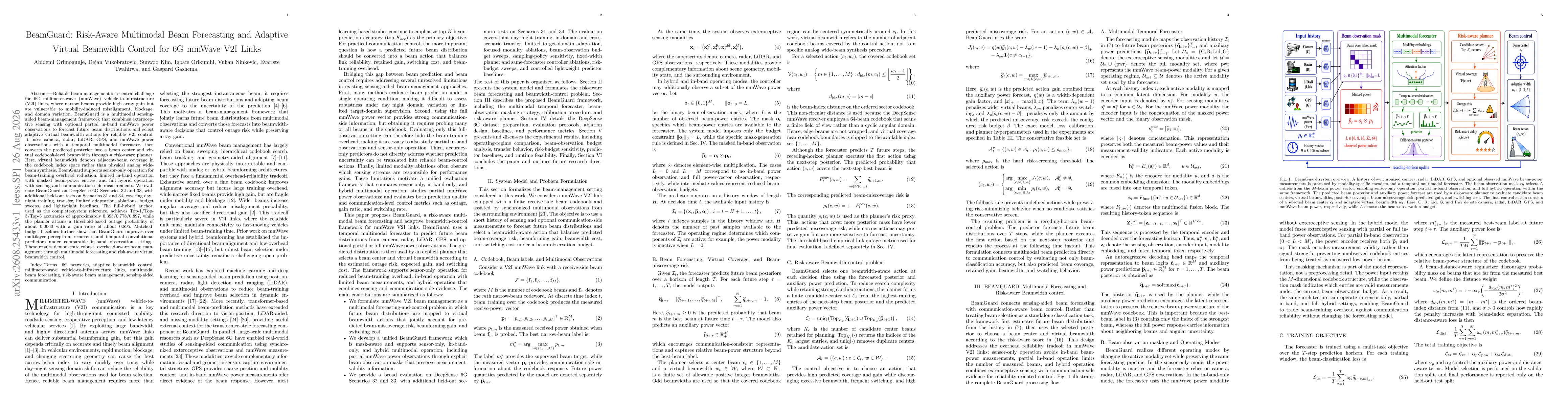
Reliable beam management is a central challenge for 6G millimeter-wave (mmWave) vehicle-to-infrastructure (V2I) links, where narrow beams provide high array gain but are vulnerable to mobility-induced misalignment, blockage, and domain variation. BeamGuard is a multimodal sensing-aided beam-management framework that combines exteroceptive sensing with optional partial in-band mmWave power observations to forecast future beam distributions and select adaptive virtual beamwidth actions for reliable V2I control. It fuses camera, radar, LiDAR, GPS, and mmWave power observations with a temporal multimodal forecaster, then converts the predicted posterior into a beam center and virtual codebook-level beamwidth through a risk-aware planner. Here, virtual beamwidth denotes adjacent-beam coverage in the codebook index space rather than physical analog wide-beam synthesis. BeamGuard supports sensor-only operation for beam-training overhead reduction, limited in-band operation with masked beam-power entries, and full hybrid operation with sensing and communication-side measurements. We evaluate BeamGuard on DeepSense 6G Scenarios 32 and 33, with additional held-out tests on Scenarios 31 and 34, covering day--night training, transfer, limited adaptation, ablations, budget sweeps, and lightweight baselines. The full-hybrid anchor, used as the complete-system reference, achieves Top-1/Top-3/Top-5 accuracies of approximately \(0.393/0.778/0.897\), while the planner attains a threshold-based outage probability of about \(0.0060\) with a gain ratio of about \(0.895\). Matched-budget baselines further show that BeamGuard improves over multilayer perceptron, recurrent, and temporal convolutional predictors under comparable in-band observation settings. These results demonstrate robust, overhead-aware beam management through multimodal forecasting and risk-aware virtual beamwidth control.
Analysis
AI-generated · verify against the original paper
Generated Aug 27, 2026ResultsWhat the authors found
- Full-hybrid anchor achieves Top-1/Top-3/Top-5 accuracies of about 0.393/0.778/0.897, demonstrating strong beam-forecasting performance under multimodal sensing.
- The risk-aware planner attains an outage probability around 0.0060 with a gain ratio near 0.895, indicating robust reliability gains at low outage rates.
- Matched-budget baselines show BeamGuard outperforming ML baselines (MLP, RNN, TCN) under comparable in-band observation settings, illustrating benefits of multimodal forecasting plus risk-aware control.
LimitationsWhere the findings need caution
- Evaluation is focused on codebook-level virtual beamwidths rather than physically synthesized wide analog beams, limiting direct assessment of wide-beam synthesis performance.
- Experiments center on single V2I link scenarios; multi-user and multi-RSU coordination remain untested in this work.
- Domain generalization is not universal across all held-out DeepSense scenarios, signaling potential gaps in cross-scenario robustness.
MethodologyHow the work was done
BeamGuard formulates mmWave V2I beam management as a multimodal forecasting and control problem, using a temporal multimodal forecaster to predict future beam distributions from camera, radar, LiDAR, GPS, and optionally partial or full mmWave power measurements, then a risk-aware planner to map forecasts to a beam center and adaptive virtual beamwidth actions. It supports sensor-only, in-band masked-power, and full hybrid operation via explicit beam-observation masking, calibration, and a planner that balances predicted outage risk, expected gain, and switching cost under a beam-observation budget. Evaluation is conducted on DeepSense 6G Scenarios 32 and 33 with held-out tests on 31 and 34, including ablations, budget sweeps, and comparisons to lightweight baselines.
SignificanceWhy the work matters
Demonstrates that integrating multimodal exteroceptive sensing with a risk-aware virtual beamwidth control framework can deliver robust, overhead-efficient beam management for 6G mmWave V2I links, balancing reliability, array gain, and switching costs across varied conditions and domain shifts.
Technical contributionsWhat the work introduces
A unified BeamGuard framework that (i) fuses multimodal exteroceptive observations with optional mmWave power measurements in a temporal forecaster, (ii) converts forecasts into beam center and adaptive virtual beamwidth via a risk-aware planner, (iii) supports sensor-only, partial in-band, and full hybrid operation through explicit beam-observation masking, and (iv) provides comprehensive evaluation across day–night, transfer, and ablation studies with multiple baselines.
NoveltyHow it differs from prior work
Introduces a risk-aware multimodal forecasting and control paradigm for mmWave V2I beam management, where predicted beam distributions are mapped to virtual beamwidth actions under an observation budget, enabling robust, low-overhead beam management in sensing-driven 6G networks.
Future workQuestions that remain
- Extend framework to physical wide-beam synthesis and multi-user coordination for RSU dense deployments.
- Investigate online domain adaptation and calibration to improve cross-scenario generalization in real-time deployments.
- Integrate hardware-aware deployment considerations on road-side edge platforms and evaluate runtime efficiency on embedded hardware.
Discussion 0