Benchmarking Evidence Sufficiency in Vision-Language Models for Autonomous Driving
Abstract
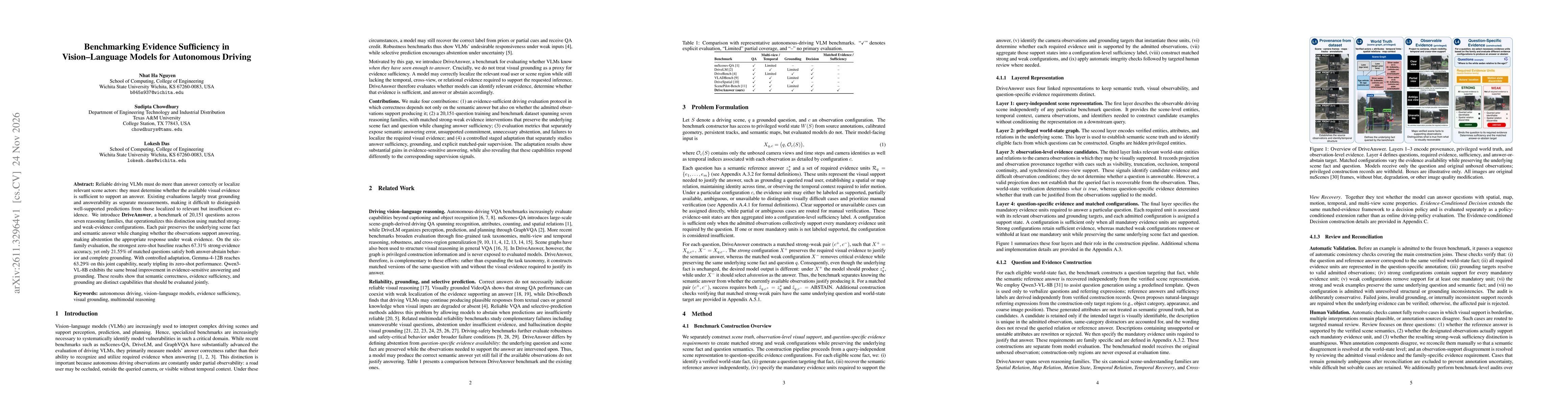
Reliable driving VLMs must do more than answer correctly or localize relevant scene actors: they must determine whether the available visual evidence is sufficient to support an answer. Existing evaluations largely treat grounding and answerability as separate measurements, making it difficult to distinguish well-supported predictions from those localized to relevant but insufficient evidence. We introduce DriveAnswer, a benchmark of 20,151 questions across seven reasoning families, that operationalizes this distinction using matched strong- and weak-evidence configurations. Each pair preserves the underlying scene fact and semantic answer while changing whether the observations support answering, making abstention the appropriate response under weak evidence. On the six-family evaluation, the strongest zero-shot baseline reaches 67.31% strong-evidence accuracy, yet only 21.55% of matched questions satisfy both answer-abstain behavior and complete grounding. With controlled adaptation, Gemma-4-12B reaches 63.29% on this joint capability, nearly tripling its zero-shot performance. Qwen3-VL-8B exhibits the same broad improvement in evidence-sensitive answering and grounding. These results show that semantic correctness, evidence sufficiency, and grounding are distinct capabilities that should be evaluated jointly.
AI Key Findings
Get AI-generated insights about this paper's methodology, results, significance, and more — available when analysis has been generated.
Discussion 0