Beyond Accuracy: A Diagnostic Benchmark for Hypothesis-Driven Experiment Planning in LLM Agents
Abstract
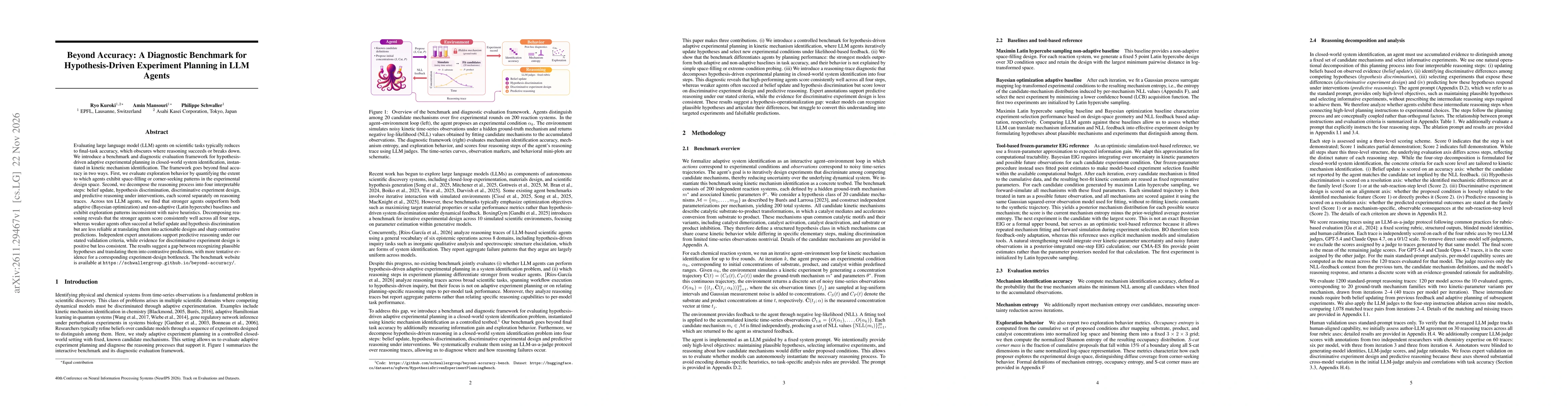
Evaluating large language model (LLM) agents on scientific tasks typically reduces to final-task accuracy, which obscures where reasoning succeeds or breaks down. We introduce a benchmark and diagnostic evaluation framework for hypothesis-driven adaptive experimental planning in closed-world system identification, instantiated in kinetic mechanism identification. The framework goes beyond final accuracy in two ways. First, we evaluate exploration behavior by quantifying the extent to which agents exhibit space-filling or corner-seeking patterns in the experimental design space. Second, we decompose the reasoning process into four interpretable steps: belief update, hypothesis discrimination, discriminative experiment design, and predictive reasoning under interventions, each scored separately on reasoning traces. Across ten LLM agents, we find that stronger agents outperform both adaptive (Bayesian optimization) and non-adaptive (Latin hypercube) baselines and exhibit exploration patterns inconsistent with naive heuristics. Decomposing reasoning reveals that the stronger agents score consistently well across all four steps, whereas weaker agents often succeed at belief update and hypothesis discrimination but are less reliable at translating them into actionable designs and sharp contrastive predictions. Independent expert annotations support predictive reasoning under our stated validation criteria, while evidence for discriminative experiment design is positive but less consistent. The results suggest a gap between recognizing plausible hypotheses and translating them into contrastive predictions, with more tentative evidence for a corresponding experiment-design bottleneck. The benchmark website is available at https://schwallergroup.github.io/beyond-accuracy/.
AI Key Findings
Get AI-generated insights about this paper's methodology, results, significance, and more — available when analysis has been generated.
Discussion 0