Beyond Feature Fusion: Sensor-Grounded Semantic-Spiking Learning for Robust Object Detection
Abstract
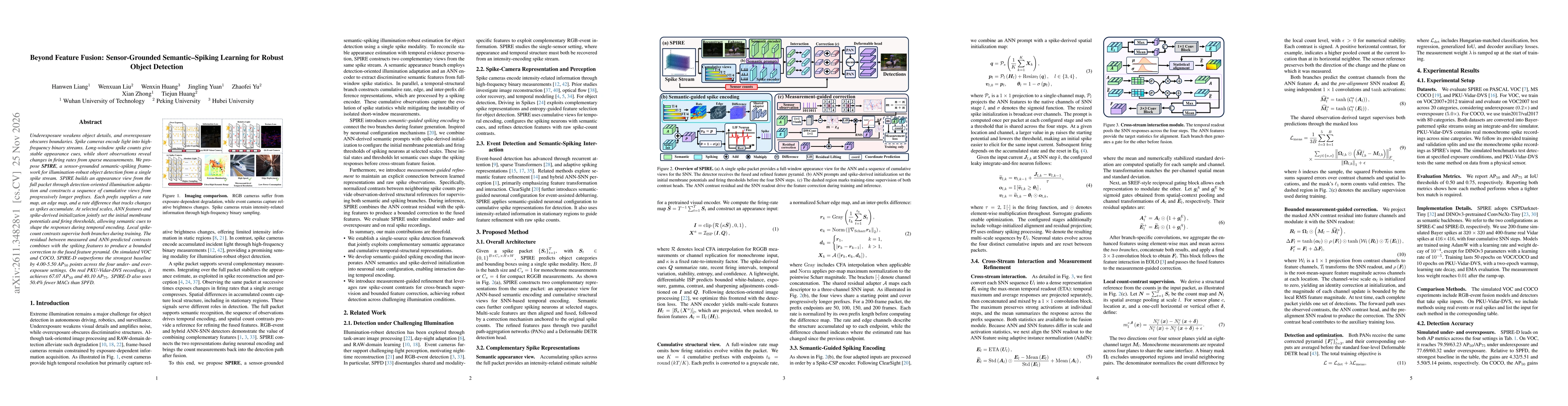
Underexposure weakens object details, and overexposure obscures boundaries. Spike cameras encode light into high-frequency binary streams. Long-window spike counts give stable appearance cues, while short observations reveal changes in firing rates from sparse measurements. We propose SPIRE, a sensor-grounded semantic-spiking framework for illumination-robust object detection from a single spike stream. SPIRE builds an appearance view from the full packet through detection-oriented illumination adaptation and constructs a sequence of cumulative views from progressively longer prefixes. Each prefix supplies a rate map, an edge map, and a rate difference that tracks changes as spikes accumulate. At selected scales, ANN features and spike-derived initialization jointly set the initial membrane potentials and firing thresholds, allowing semantic cues to shape the responses during temporal encoding. Local spike-count contrasts supervise both branches during training. The residual between measured and ANN-predicted contrasts combines with the spiking features to produce a bounded correction to the fused feature pyramid. On simulated VOC and COCO, SPIRE-D outperforms the strongest baseline by 4.00-5.50 AP50 points across the four under- and overexposure settings. On real PKU-Vidar-DVS recordings, it achieves 67.07 AP50 and 40.10 AP75. SPIRE-D also uses 50.4% fewer MACs than SPFD.
Analysis
AI-generated · verify against the original paper
Generated Jan 1, 0001ResultsWhat the authors found
- On simulated VOC and COCO under four exposure settings, SPIRE‑D outperforms the strongest baseline by 4.00–5.50 AP50 points.
- On real PKU‑Vidar‑DVS recordings, SPIRE‑D achieves 67.07 AP50 and 40.10 AP75.
- SPIRE‑D uses 50.4% fewer MACs than the SPFD baseline.
MethodologyHow the work was done
SPIRE constructs two complementary representations from a single spike stream: an appearance view using full‑packet illumination adaptation and ANN features, and cumulative temporal‑structural views (rate map, edge map, rate difference) from progressively longer prefixes processed by a spiking encoder. Semantic cues initialize membrane potentials and firing thresholds of spiking neurons, and local spike‑count contrasts supervise both branches. The residual between measured and ANN‑predicted contrasts is fused with spiking features to correct the feature pyramid before detection.
SignificanceWhy the work matters
The framework enables illumination‑robust object detection from a single spike camera, combining semantic and temporal information while reducing computational cost, which is valuable for autonomous driving and low‑power vision systems.
Technical contributionsWhat the work introduces
Introduces semantic‑guided spiking encoding that configures spiking neuron states with ANN‑derived cues, and measurement‑guided refinement that leverages raw spike‑count contrasts for cross‑branch supervision and bounded feature correction.
NoveltyHow it differs from prior work
First sensor‑grounded approach that jointly exploits full‑packet semantic appearance and cumulative temporal‑structural spike representations within a single spike modality for robust object detection.
Discussion 0