Beyond Hard Tokens: Predictive Memory for Multimodal Protein Generation
Abstract
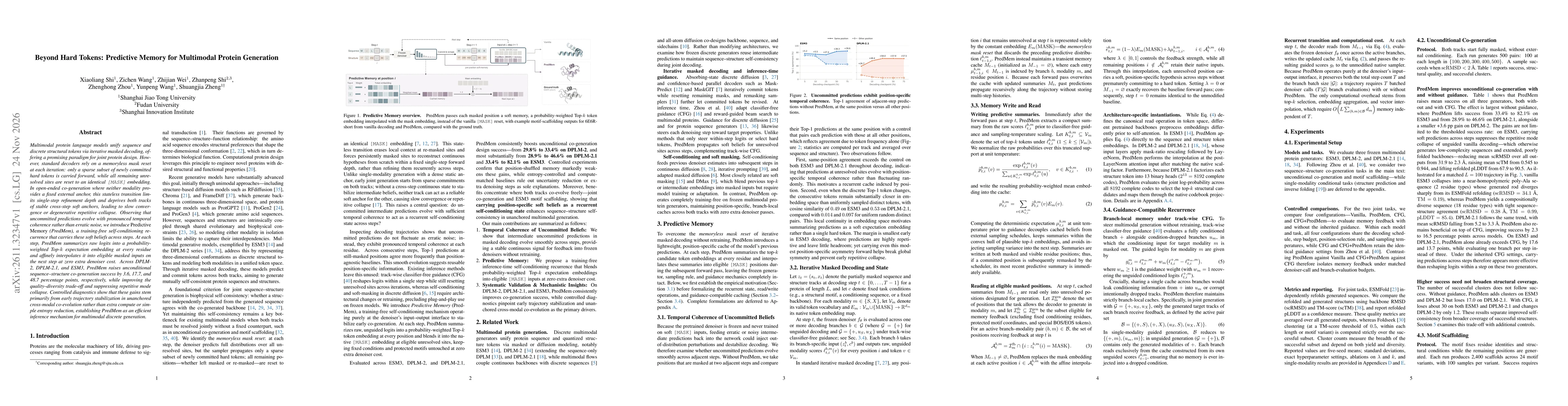
Multimodal protein language models unify sequence and discrete structural tokens via iterative masked decoding, offering a promising paradigm for joint protein design. However, standard decoders rely on a memoryless mask reset at each iteration: only a sparse subset of newly committed hard tokens is carried forward, while all remaining unresolved sites are reset to an identical [MASK] embedding. In open-ended co-generation where neither modality provides a fixed external anchor, this stateless transition limits single-step refinement depth and deprives both tracks of stable cross-step soft anchors, leading to slow convergence or degenerative repetitive collapse. Observing that uncommitted predictions evolve with pronounced temporal coherence rather than erratic noise, we introduce Predictive Memory (PredMem), a training-free self-conditioning recurrence that carries these soft beliefs across steps. At each step, PredMem summarizes raw logits into a probability-weighted Top-$k$ expectation embedding at every residue and affinely interpolates it into eligible masked inputs on the next step at zero extra denoiser cost. Across DPLM-2, DPLM-2.1, and ESM3, PredMem raises unconditional sequence-structure co-generation success by 3.6, 17.7, and 48.7 percentage points, respectively, while improving the quality-diversity trade-off and suppressing repetitive mode collapse. Controlled diagnostics show that these gains stem primarily from early trajectory stabilization in unanchored cross-modal co-evolution rather than extra compute or simple entropy reduction, establishing PredMem as an efficient inference mechanism for multimodal discrete generation.
Analysis
AI-generated · verify against the original paper
Generated Jan 1, 0001ResultsWhat the authors found
- PredMem increases unconditional sequence‑structure co‑generation success by 3.6 pp on DPLM‑2, 17.7 pp on DPLM‑2.1, and 48.7 pp on ESM3.
- Quality‑diversity trade‑off improves and repetitive mode collapse is suppressed across all three models.
- Controlled diagnostics show gains stem from early trajectory stabilization rather than extra compute or entropy reduction.
- Runtime overhead is modest: 3.0–3.2 % decoding time on ESM3 and 12.4–13.2 % on DPLM‑2.1, with VRAM increase ≤0.026 GiB.
- Under classifier‑free guidance, overhead rises to 3.8–4.5 % (ESM3) and 8.9–13.2 % (DPLM‑2.1) with ≤0.12 GiB extra VRAM.
LimitationsWhere the findings need caution
- PredMem is evaluated only on frozen multimodal protein models (ESM3, DPLM‑2, DPLM‑2.1) and may not generalize to models requiring architectural changes.
- Memory and runtime overhead, though modest, increase with classifier‑free guidance and longer sequences.
MethodologyHow the work was done
The authors introduce Predictive Memory (PredMem), a training‑free self‑conditioning recurrence that, at each decoding step, summarizes raw logits into a probability‑weighted top‑k expectation embedding per residue and affinely interpolates this embedding into eligible masked inputs for the next step, without extra denoiser cost.
SignificanceWhy the work matters
PredMem provides an efficient inference‑time mechanism that leverages temporal coherence of uncommitted predictions to stabilize multimodal protein generation, enabling higher success rates without retraining or additional computational burden.
Technical contributionsWhat the work introduces
A plug‑and‑play inference technique that injects a soft memory of top‑k token expectations into masked positions, turning the stateless mask reset into a recurrent self‑conditioning process.
NoveltyHow it differs from prior work
The work reveals and exploits the temporal coherence of intermediate uncommitted predictions, introducing a training‑free self‑conditioning recurrence that improves multimodal protein generation without modifying model parameters.
Discussion 0