Beyond Self-Consistency: Recursive Self-Improvement at Test Time
Abstract
Large language models (LLMs) that continue improving after deployment (e.g., recursive self-improvement) offer a promising path toward general intelligence. Current test-time methods pursue this goal on unlabeled questions, primarily relying on self-consistency: they generate independent solutions and use majority voting to select an answer or construct training targets. This leaves earlier reasoning unused at inference and can reinforce an incorrect majority during training. Humans instead build on earlier attempts to preserve useful reasoning, correct mistakes and improve their problem-solving strategies. Following this principle, we propose Test-Time Recursive Self-Improvement (TT-RSI), a label-free framework for improving LLMs at test time through two mutually reinforcing components: (1) In-Context RSI repeatedly re-solves each question using the full previous solution as a reference, letting the model decide whether and how to use it so that inference compute builds on earlier reasoning. (2) In-Weight RSI distills successive refinements into the model's weights, enabling progress beyond an initially wrong majority and theoretically bringing the first attempt toward the model's infinite-step refinement limit. The updated model answers better and refines more effectively, generating stronger references for subsequent training. Extensive experiments show that TT-RSI improves average accuracy by +13.89% over the base model and outperforms the strongest self-consistency-based method by +4.79% under the same test-time scaling budget.
Analysis
AI-generated · verify against the original paper
Generated Jan 1, 0001ResultsWhat the authors found
- TT‑RSI improves average accuracy by +13.89% over the base model on five mathematics benchmarks.
- In‑Weight RSI alone yields a +5.79% accuracy gain, while the full TT‑RSI pipeline achieves the full +13.89% gain.
- TT‑RSI outperforms the strongest self‑consistency‑based method (TT‑PO+SC) by +4.79% under the same test‑time scaling budget.
- In‑Context RSI reduces generated tokens by 68.6% compared to self‑consistency while achieving higher accuracy.
LimitationsWhere the findings need caution
- The approach relies on additional inference compute for multiple refinement steps, which may limit practicality in low‑resource settings.
- Repeated conditioning on previous solutions can restrict exploration and cause repetition if not carefully managed.
MethodologyHow the work was done
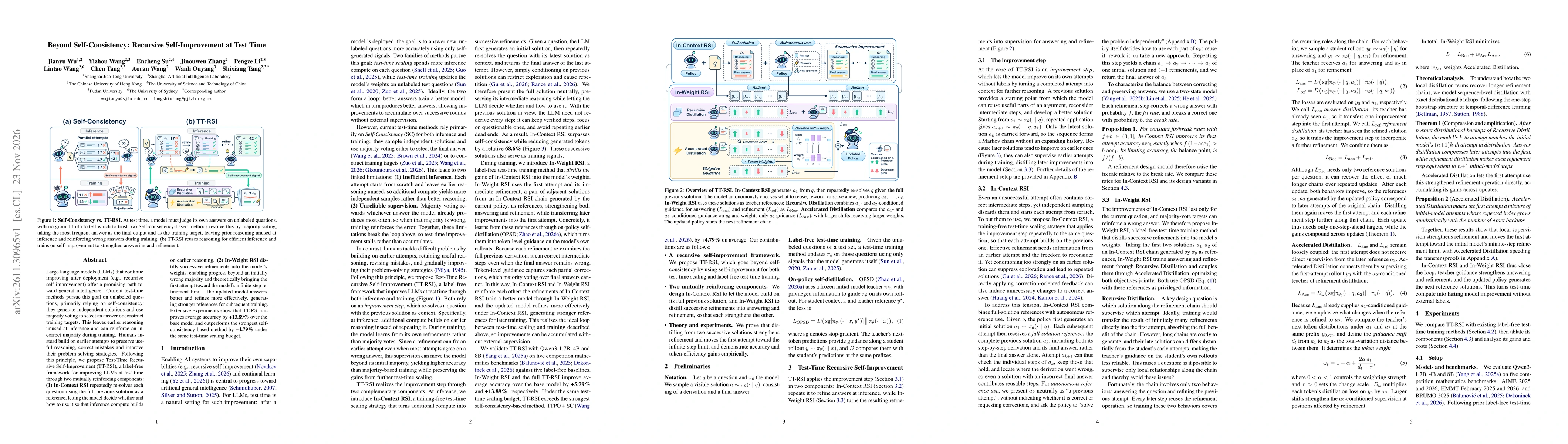
The paper introduces Test-Time Recursive Self-Improvement (TT‑RSI), a label‑free framework that improves large language models at test time via two mutually reinforcing components: (1) In‑Context RSI repeatedly re‑solves each question using the full previous solution as context, allowing the model to build on earlier reasoning; and (2) In‑Weight RSI distills successive refinements into the model’s weights through on‑policy self‑distillation, enabling progress beyond an initially wrong majority and iteratively strengthening both answering and refinement.
SignificanceWhy the work matters
TT‑RSI demonstrates that label‑free test‑time recursive self‑improvement can substantially boost LLM performance without external supervision, addressing the inefficiencies and error reinforcement of self‑consistency methods and moving toward more autonomous, continually improving AI systems.
Technical contributionsWhat the work introduces
A unified test‑time framework that couples inference‑time recursive refinement (In‑Context RSI) with weight‑level self‑distillation (In‑Weight RSI), enabling models to iteratively improve their own reasoning and internal parameters without labeled data.
NoveltyHow it differs from prior work
First label‑free test‑time method that leverages both in‑context solution reuse and in‑weight distillation to achieve recursive self‑improvement, overcoming the majority‑vote limitation of self‑consistency.
Discussion 0