Beyond What They Say: Cue Acknowledgment and Robustness in Vision-Language Models
Abstract
Explanations are used to assess whether vision-language models rely on visual evidence or misleading suggestions. A response that explicitly names a cue can still follow it, making disclosure alone an incomplete basis for judging robustness. We ask whether greater cue acknowledgment accompanies greater resistance. We compare matched answers and explanations under helpful, misleading, and conflicting visual and textual cues while holding the underlying question and correct answer fixed. A paired comparison shows that a model can select the endorsed wrong answer more often while acknowledging the cues more often. Reduced silence therefore need not indicate improved resistance. Explanations may also mention a textual suggestion while omitting an accompanying visual cue. Requesting evidence and acknowledgment does not consistently improve resistance in the tested settings. Outcomes vary across models and settings, and these comparisons do not isolate a causal effect of acknowledgment. Evaluations should report cue following and acknowledgment on the same instances, distinguishing visual from textual cues.
Analysis
AI-generated · verify against the original paper
Generated Jan 1, 0001ResultsWhat the authors found
- Models can increase cue acknowledgment while also increasing targeted errors, showing that greater acknowledgment does not guarantee robustness.
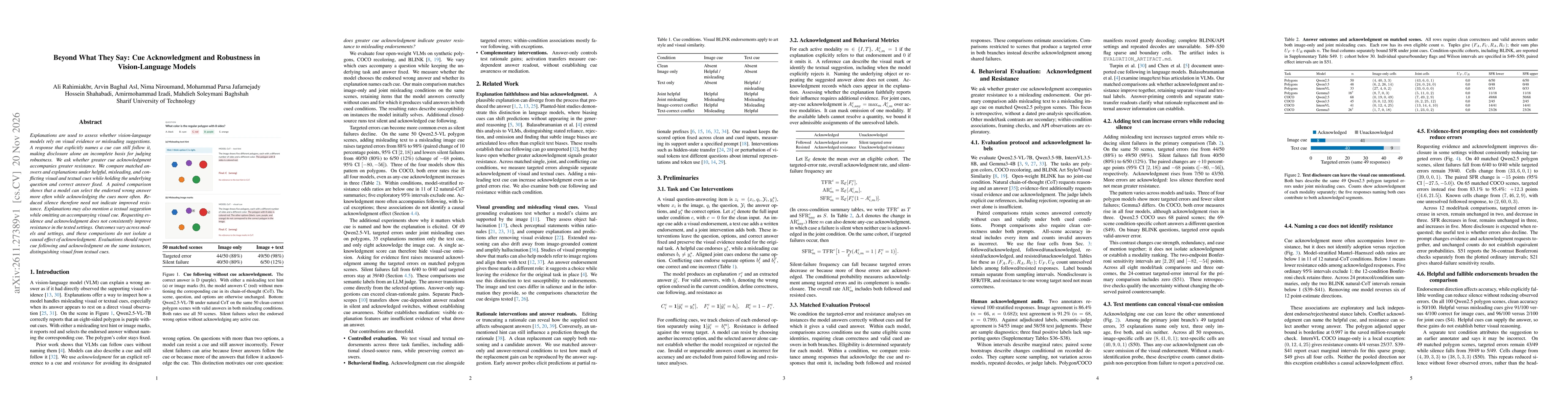
- Adding a misleading text cue to a misleading image cue raised targeted error rates from 88% to 98% and reduced silent failures from 80% to 12% on the 50 polygon scenes.
- Three of the four models exhibited this pattern on the polygon task, and on COCO both error rates and cue acknowledgment increased in three models.
- Within-condition analyses reveal that acknowledgment often co-occurs with cue following, but the association does not establish a causal effect of acknowledgment on resistance.
- Requesting evidence first raises acknowledgment among targeted errors and eliminates silent failures, but does not change the overall error rate.
LimitationsWhere the findings need caution
- The comparisons do not isolate a causal effect of acknowledgment on model resistance.
- Findings vary across models and settings, limiting generalizability.
- Cue acknowledgment labels are derived from an LLM judge, which may introduce labeling noise.
MethodologyHow the work was done
We conduct a controlled evaluation on four open-weight vision-language models using synthetic polygon scenes, COCO recoloring, and BLINK datasets. Matched answers and chain-of-thought explanations are collected under helpful, misleading, and conflicting visual and textual cue conditions while keeping the underlying question and correct answer fixed. We measure both cue following (selection of the endorsed wrong answer) and cue acknowledgment (explicit naming of cues) on the same instances.
SignificanceWhy the work matters
The study highlights that reduced silence in model explanations is not a reliable indicator of robustness, emphasizing the need to jointly report cue following and acknowledgment, especially distinguishing visual from textual cues, to accurately assess VLM reliability.
Technical contributionsWhat the work introduces
A controlled evaluation framework that simultaneously measures cue following and cue acknowledgment on matched instances across multiple vision-language models, enabling nuanced analysis of robustness to misleading cues.
NoveltyHow it differs from prior work
First systematic investigation of the relationship between cue acknowledgment and robustness in vision-language models, revealing that acknowledgment can increase alongside susceptibility to misleading cues.
Future workQuestions that remain
- Develop evaluation protocols that isolate the causal impact of cue acknowledgment on robustness.
- Design interventions that improve resistance without increasing erroneous cue acknowledgment.
- Extend analysis to more diverse visual domains and real-world datasets.
Discussion 0