Beyond Which: Where, How, and When in Vision-Language-Action Models
Abstract
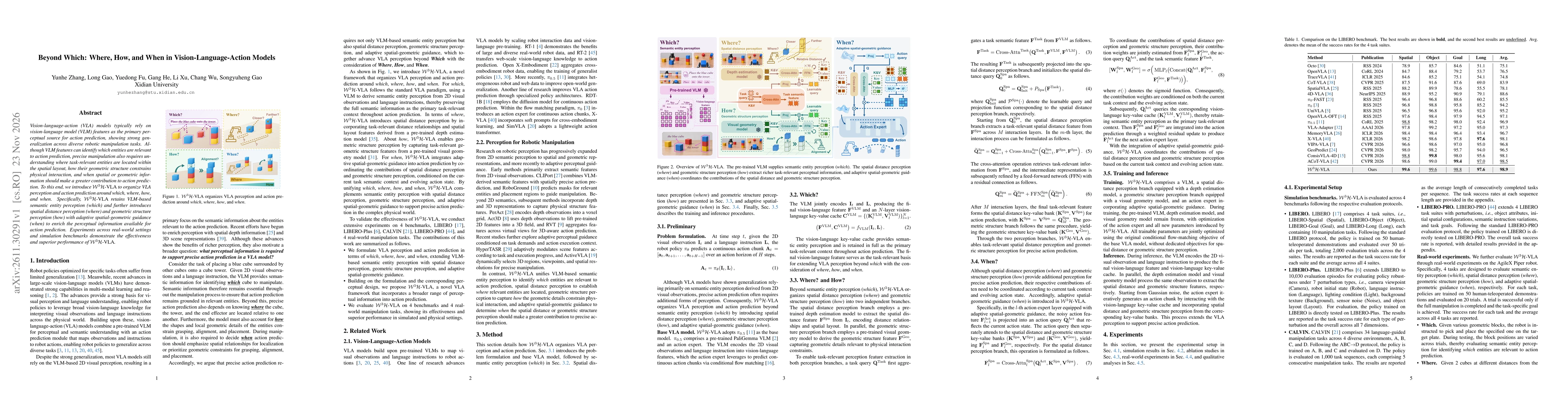
Vision-language-action (VLA) models typically rely on vision-language model (VLM) features as the primary perceptual source for action prediction, showing strong generalization across diverse robotic manipulation tasks. Although VLM features can identify which entities are relevant to action prediction, precise manipulation also requires understanding where task-relevant entities are located within the spatial layout, how their geometric structure constrains physical interaction, and when spatial or geometric information should make a greater contribution to action prediction. To this end, we introduce {\mathcal{W}^{3}\mathcal{H}}-VLA to organize VLA perception and action prediction around which, where, how, and when. Specifically, {\mathcal{W}^{3}\mathcal{H}}-VLA retains VLM-based semantic entity perception which and further introduces spatial distance perception where and geometric structure perception how with adaptive spatial-geometric guidance when to enrich the perceptual information available for action prediction. Experiments across real-world settings and simulation benchmarks demonstrate the effectiveness and superior performance of {\mathcal{W}^{3}\mathcal{H}}-VLA.
AI Key Findings
Get AI-generated insights about this paper's methodology, results, significance, and more — available when analysis has been generated.
Discussion 0