Bistatic Integrated Sensing and Communications with Flexible Intelligent Metasurfaces
Abstract
We propose a novel doubly-dispersive (DD) multiple-input multiple-output (MIMO) channel model incorporating flexible intelligent metasurfaces (FIMs), suitable for integrated sensing and communications (ISAC) in high-mobility scenarios. We show how the proposed FIM-parameterized DD (FPDD) channel model extends to multicarrier waveforms known to perform well in DD environments, namely, orthogonal frequency division multiplexing (OFDM), orthogonal time frequency space (OTFS), and affine frequency division multiplexing (AFDM). Leveraging this model, we formulate an achievable rate maxi-mization problem with a sensing constraint for all waveforms and solve it via gradient ascent with closed-form gradients. Numerical results indicate that FIM technology significantly impacts the achievable rate, with careful parametrization essential for strong ISAC performance across all waveforms.
Analysis
AI-generated · verify against the original paper
Generated Aug 4, 2026ResultsWhat the authors found
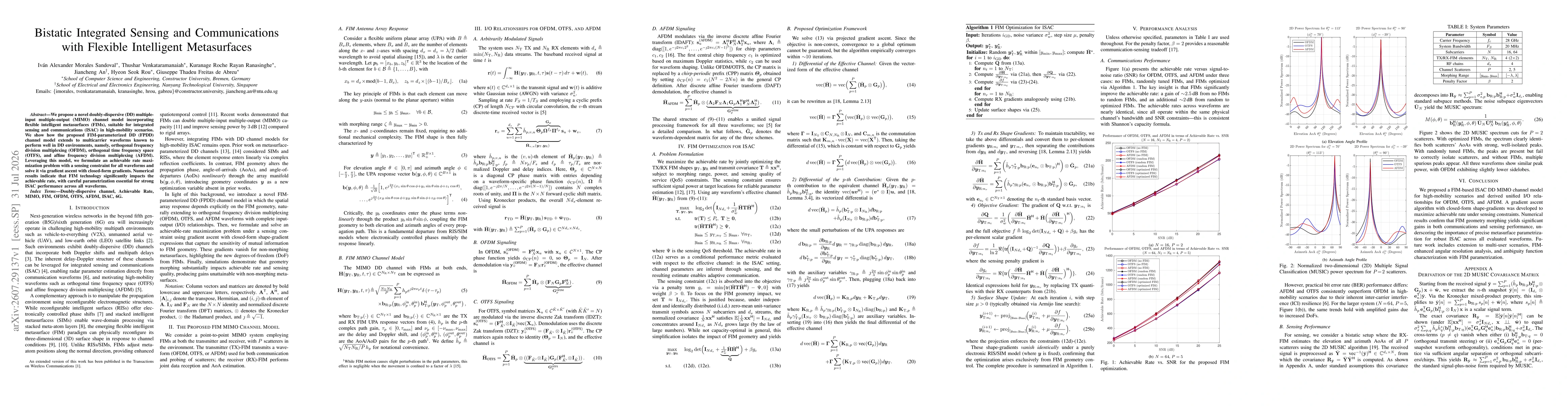
- FIM-enabled optimization yields substantial rate gains (approximately 2.5 dB over non-FIM cases, and about 2 dB over randomly-tuned FIMs) across OFDM, OTFS, and AFDM in high-mobility DD channels.
- Across OFDM, OTFS, and AFDM, optimized FIM configurations achieve nearly identical achievable rates, highlighting that the rate is governed primarily by the physical channel bandwidth and SNR rather than waveform choice.
- Sensing performance, quantified via 2D MUSIC AoA estimation, improves with optimized FIM morphing, enabling clearer and more isolated AoA peaks for multiple scatterers.
- Gradients vanish when FIM geometry is fixed (purely electronic RIS/SIM), validating that gains arise from FIM geometry optimization rather than surface phase control alone.
LimitationsWhere the findings need caution
- Evaluation is conducted under specific system parameters (e.g., 28 GHz, 20 MHz bandwidth, small NTx/NRX), which may limit direct generalization to different frequencies or larger-scale deployments.
- Assumes accurate channel knowledge and MUSIC-based AoA estimation; practical hardware imperfections and real-time computational constraints may affect performance.
- The model considers bistatic geometry with morphable FIMs but does not extensively address multi-user interference or mobility-induced model mismatch over longer horizons.
MethodologyHow the work was done
We propose a novel FPDD channel model that parameterizes DD MIMO channels with Flexible Intelligent Metasurfaces (FIMs) at both transmitter and receiver, enabling joint ISAC design. The model derives I/O relationships for OFDM, OTFS, and AFDM by formulating the DD channel incorporating FIM geometry, followed by a gradient-ascent optimization framework that updates FIM surface shapes using closed-form shape gradients under a sensing-augmented rate objective. The optimization relies on per-element gradients and a projection step to enforce physical morphology constraints, enabling simultaneous enhancement of communication rate and sensing accuracy.
SignificanceWhy the work matters
Demonstrates that geometry-aware metasurface morphing (FIMs) introduces new degrees of freedom that significantly boost ISAC performance in DD MIMO channels, enabling high-mobility scenarios to attain substantial mutual information gains and improved sensing resolutions across multiple multicarrier waveforms.
Technical contributionsWhat the work introduces
Introduces a FPDD channel model that explicitly couples FIM geometry to the propagation manifold, deriving unified input-output relations for OFDM, OTFS, and AFDM, and develops a gradient-based optimization algorithm with closed-form surface-shape gradients for joint communication-sensing enhancement.
NoveltyHow it differs from prior work
Presents the first FIM-parameterized DD MIMO channel framework that enables geometry-aware optimization of metasurface morphing for ISAC across multiple multicarrier waveforms, distinguishing itself from prior RIS/SIM-based approaches by modeling non-linear dependence of the response on FIM geometry and providing a tractable gradient-based solution.
Future workQuestions that remain
- Extend to multi-user ISAC scenarios to study inter-user interference and coordination of FIM morphing across users.
- Investigate FIM-enhanced angular-resolution analyses and ambiguity function characterization under realistic hardware and calibration errors.
- Explore robustness to model mismatches and develop low-complexity, real-time gradient computations for larger-scale metasurface deployments.
Discussion 0