Bottom-Up FPGA Reconfigurable Accelerator Overlay Generation
Abstract
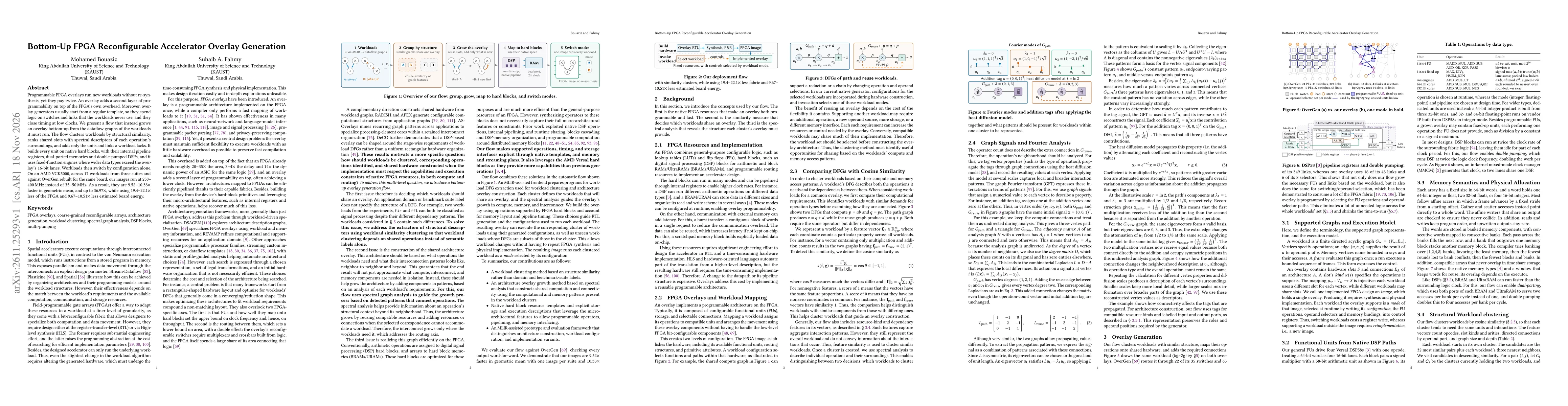
Programmable FPGA overlays run new workloads without re-synthesis, yet they pay twice. An overlay adds a second layer of programmability on top of the FPGA's own overhead. Moreover, overlay generators usually start from a regular template, so they spend logic on switches and links that the workloads never use, and they close timing at low clocks. We present a flow that instead grows an overlay bottom-up from the dataflow graphs of the workloads it must run. The flow clusters workloads by structural similarity, ranks shared slots with spectral descriptors of each operation's surroundings, and adds only the units and links a workload lacks. It builds every unit on native hard blocks, with their internal pipeline registers, dual-ported memories and double-pumped DSPs, and it uses fixed-function engines where wider data types exceed the overlay's 16-bit lanes. Workloads then switch by configuration alone. On an AMD VCK5000, across 17 workloads from three suites and against OverGen rebuilt for the same board, our images run at 250-400 MHz instead of 35-50 MHz. As a result, they are 9.52-10.33x faster in geometric mean, and up to 36.97x, while using 19.4-22.1x less of the FPGA and 9.67-10.51x less estimated board energy.
Analysis
AI-generated · verify against the original paper
Generated Jan 1, 0001ResultsWhat the authors found
- Generated overlays run at 250–400 MHz on an AMD VCK5000, compared to 35–50 MHz for the OverGen baseline.
- Achieved a geometric‑mean speedup of 9.52–10.33× (up to 36.97×) over OverGen.
- Used 19.4–22.1× less FPGA area and 9.67–10.51× less estimated board energy than the baseline.
MethodologyHow the work was done
The authors propose a bottom‑up overlay generation flow that clusters workloads by structural similarity, ranks shared slots using spectral descriptors of operation neighborhoods, and incrementally adds only the compute units and interconnect links missing for each workload. The overlay is built from native FPGA hard blocks (DSPs, dual‑ported memories, double‑pumped pipelines) and employs fixed‑function engines for wider data types, enabling workload switching via configuration alone.
SignificanceWhy the work matters
This work demonstrates that constructing FPGA overlays from the bottom up, directly from workload dataflow graphs and native hard‑block primitives, can dramatically improve performance, resource efficiency, and energy consumption while eliminating the need for full re‑synthesis on workload changes.
Technical contributionsWhat the work introduces
A complete automated flow that integrates workload clustering, spectral graph analysis, and hard‑block‑aware overlay growth, producing configurable overlays that avoid unnecessary logic and achieve high clock frequencies.
NoveltyHow it differs from prior work
The approach uniquely grows the overlay bottom‑up from actual workload graphs, uses spectral descriptors for slot ranking, and maps exclusively to native FPGA hard blocks, contrasting with prior overlay generators that start from generic templates.
Discussion 0