BridgeMVS: Bridging Multi-View Stereo and Monodepth via Bidirectional Dynamic Fusion
Abstract
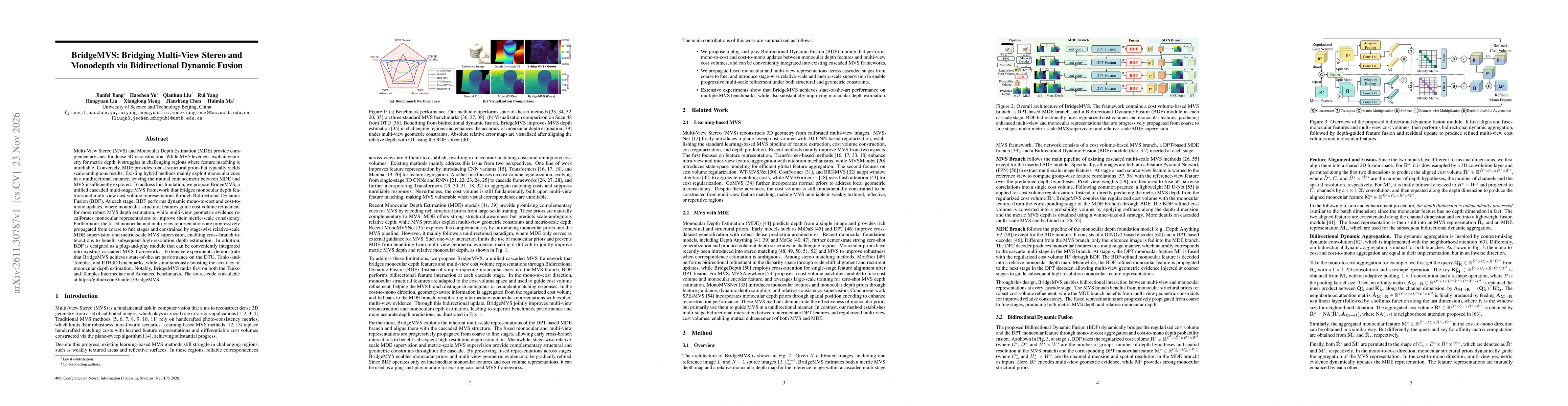
Multi-View Stereo (MVS) and Monocular Depth Estimation (MDE) provide complementary cues for dense 3D reconstruction. While MVS leverages explicit geometry for metric depth, it struggles in challenging regions where feature matching is unreliable. Conversely, MDE provides robust structural priors but typically yields scale-ambiguous results. Existing hybrid methods mainly exploit monocular cues in a unidirectional manner, leaving the mutual enhancement between MDE and MVS insufficiently explored. To address this limitation, we propose BridgeMVS, a unified cascaded multi-stage MVS framework that bridges monocular depth features and multi-view cost volume representations through Bidirectional Dynamic Fusion (BDF). At each stage, BDF performs dynamic mono-to-cost and cost-to-mono updates, where monocular structural features guide cost volume refinement for more robust MVS depth estimation, while multi-view geometric evidence recalibrates monocular representations to improve their metric-scale consistency. Furthermore, the fused monocular and multi-view representations are progressively propagated from coarse to fine stages and constrained by stage-wise relative-scale MDE supervision and metric-scale MVS supervision, enabling cross-branch interactions to benefit subsequent high-resolution depth estimation. In addition, BDF is designed as a plug-and-play module that can be conveniently integrated into existing cascaded MVS frameworks. Extensive experiments demonstrate that BridgeMVS achieves state-of-the-art performance on the DTU, Tanks-and-Temples, and ETH3D benchmarks, while simultaneously boosting the accuracy of monocular depth estimation. Notably, BridgeMVS ranks first on both the Tanks-and-Temples Intermediate and Advanced benchmarks. The source code is available at \href{https://github.com/JianfeiJ/BridgeMVS}{https://github.com/JianfeiJ/BridgeMVS}.
Analysis
AI-generated · verify against the original paper
Generated Jan 1, 0001ResultsWhat the authors found
- BridgeMVS achieves state-of-the-art performance on the DTU, Tanks-and-Temples, and ETH3D benchmarks.
- It ranks first on both the Tanks-and-Temples Intermediate and Advanced benchmarks.
- The method simultaneously boosts the accuracy of monocular depth estimation.
MethodologyHow the work was done
BridgeMVS is a unified cascaded multi-stage MVS framework that integrates monocular depth features and multi-view cost volume representations through a Bidirectional Dynamic Fusion (BDF) module. At each stage, BDF performs dynamic mono-to-cost updates, where monocular structural features guide cost volume refinement, and cost-to-mono updates, where geometric evidence from the cost volume recalibrates monocular representations. The fused representations are progressively propagated across stages and supervised by stage-wise relative-scale MDE and metric-scale MVS losses.
SignificanceWhy the work matters
The bidirectional dynamic fusion enables mutual enhancement between MVS and monocular depth estimation, addressing the limitations of previous unidirectional hybrid methods and improving both metric-scale depth reconstruction and structural depth quality.
Technical contributionsWhat the work introduces
Introduction of the Bidirectional Dynamic Fusion (BDF) module, a plug-and-play component that performs bidirectional feature interaction between monocular depth cues and multi-view cost volumes within a cascaded MVS pipeline.
NoveltyHow it differs from prior work
First approach to bridge MVS and monocular depth estimation via bidirectional updates, allowing both monocular features to refine cost volumes and cost-volume geometry to recalibrate monocular representations across multiple cascade stages.
Discussion 0