Broadband Polarization Compensation with Link Segment Reconstruction for Quantum Optical Links
The paper presents a four-wave-plate compensator that can realize any polarization change across a broad wavelength range, paired with an eight-Stokes protocol to independently characterize the two segments around the compensator. Experiments show sub-percent quantum bit error rates even far from the design wavelength, with temperature-driven drift tracked using auxiliary wavelengths, enabling flexible, non-interruptive polarization control in wavelength-division-multiplexed quantum links.
Abstract
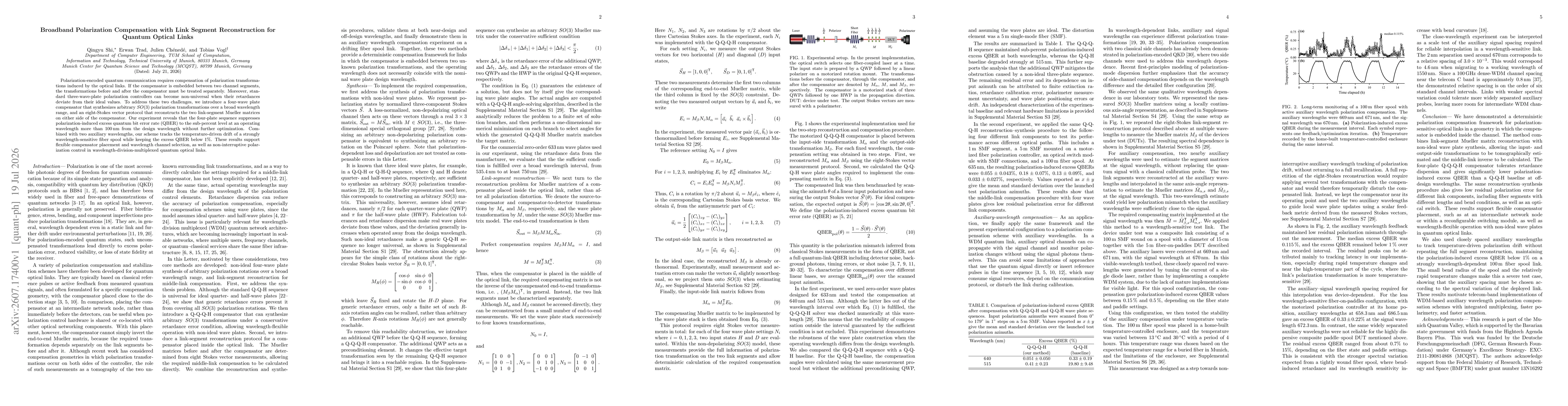
Polarization-encoded quantum communication requires compensation of polarization transformations induced by the optical links. If the compensator is embedded between two channel segments, the transformations before and after the compensator must be treated separately. Moreover, standard three-wave-plate polarization controllers can become non-universal when their retardances deviate from their ideal values. To address these two challenges, we introduce a four-wave plate compensator that synthesizes arbitrary SO(3) polarization transformations over a broad wavelength range, and an eight-Stokes vector protocol that reconstructs the two link-segment Mueller matrices on either side of the compensator. Our experiment reveals that the four-plate sequence suppresses polarization-induced excess quantum bit error rate (QBER) to the sub-percent level at an operating wavelength more than 100 nm from the design wavelength without further optimization. Combined with two auxiliary wavelengths, our scheme tracks the temperature-driven drift of a strongly wavelength-sensitive fiber spool while keeping the excess QBER below 1%. These results support flexible compensator placement and wavelength channel selection, as well as non-interruptive polarization control in wavelength-division-multiplexed quantum optical links.
AI Key Findings
Get AI-generated insights about this paper's methodology, results, significance, and more — available when analysis has been generated.
Discussion 0