Caenorhabditis elegans and the network control framework - FAQs
Abstract
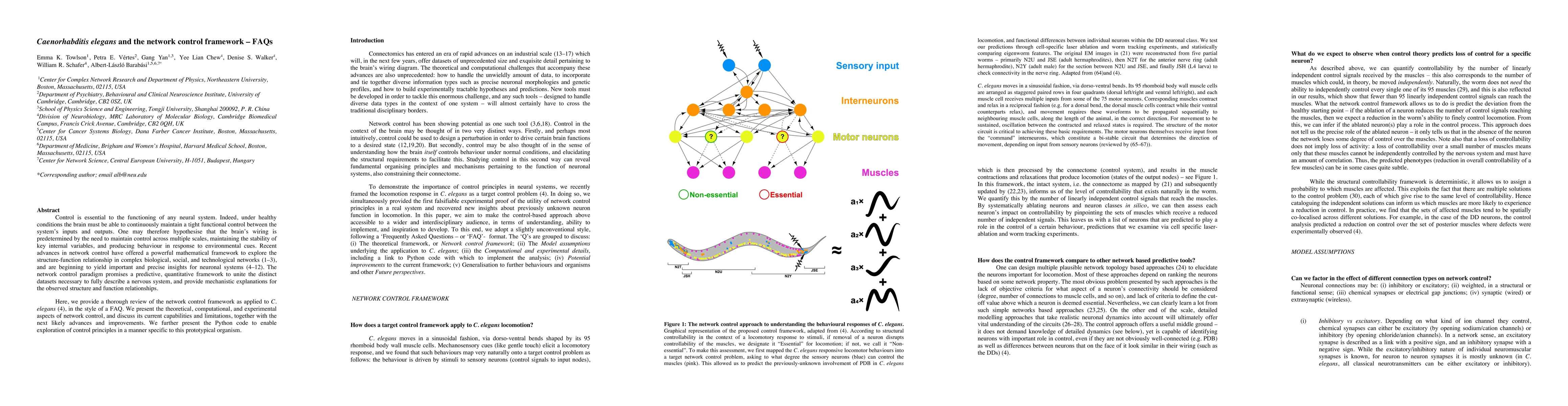
Control is essential to the functioning of any neural system. Indeed, under healthy conditions the brain must be able to continuously maintain a tight functional control between the system's inputs and outputs. One may therefore hypothesise that the brain's wiring is predetermined by the need to maintain control across multiple scales, maintaining the stability of key internal variables, and producing behaviour in response to environmental cues. Recent advances in network control have offered a powerful mathematical framework to explore the structure-function relationship in complex biological, social, and technological networks, and are beginning to yield important and precise insights for neuronal systems. The network control paradigm promises a predictive, quantitative framework to unite the distinct datasets necessary to fully describe a nervous system, and provide mechanistic explanations for the observed structure and function relationships. Here, we provide a thorough review of the network control framework as applied to C. elegans, in the style of a FAQ. We present the theoretical, computational, and experimental aspects of network control, and discuss its current capabilities and limitations, together with the next likely advances and improvements. We further present the Python code to enable exploration of control principles in a manner specific to this prototypical organism.
AI Key Findings
Get AI-generated insights about this paper's methodology, results, significance, and more — available when analysis has been generated.
Discussion 0