Summary: This research explores the capability of the LLM, specifically ChatGPT, to perform a straightforward task of counting letter occurrences in words, proposing an effective method to enhance its performance on such simple tasks. The study investigates potential improvements for LLMs in executing basic linguistic functions.
Abstract
Large language models (LLMs) struggle on simple tasks such as counting the number of occurrences of a letter in a word. In this paper, we investigate if ChatGPT can learn to count letters and propose an efficient solution.
Analysis
AI-generated · verify against the original paper
Generated Jun 11, 2025ResultsWhat the authors found
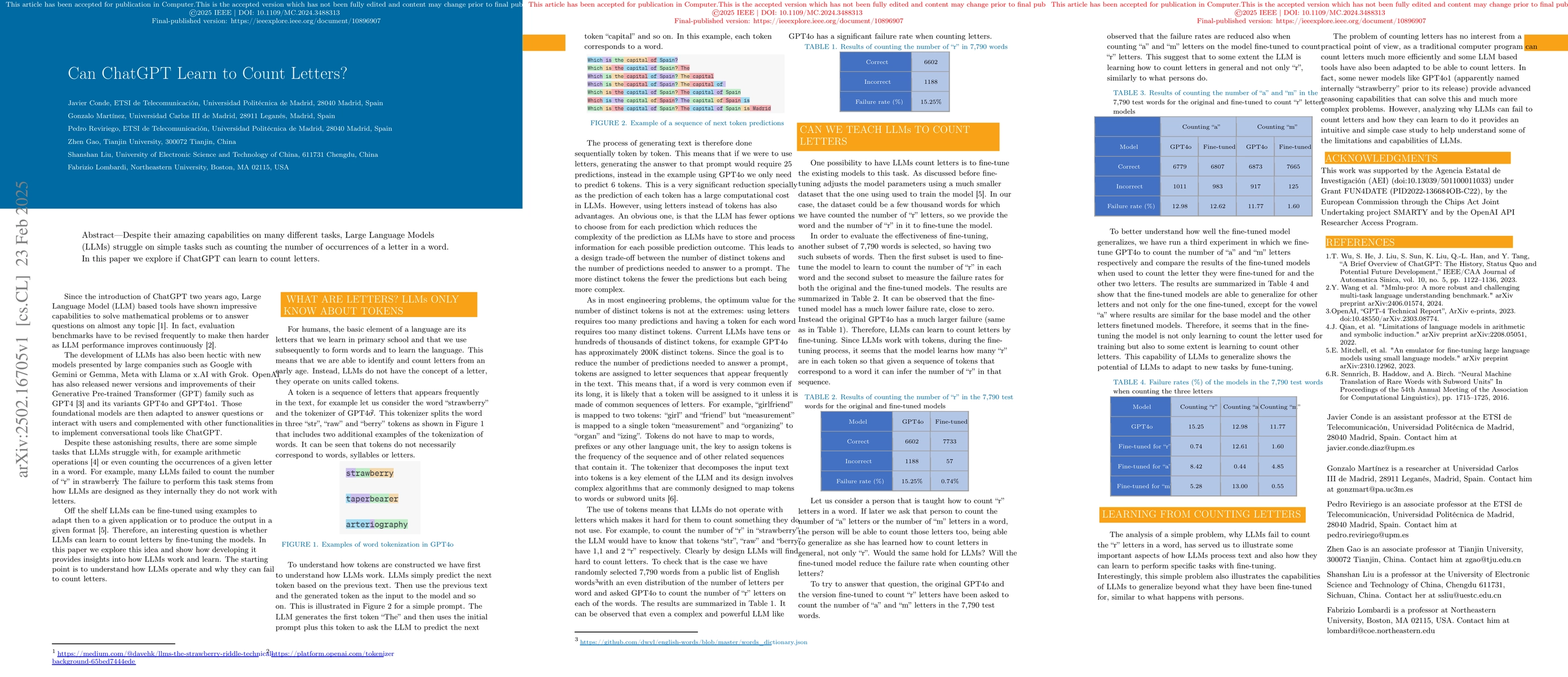
- Fine-tuning GPT-4 to count 'r' letters significantly reduces failure rate (from 15.25% to 0.74%).
- Fine-tuned model also shows improved performance when counting other letters ('a' and 'm'), indicating generalization capability.
LimitationsWhere the findings need caution
- The study is limited to counting a single letter ('r') and its generalization to other letters.
- Practical efficiency of LLMs for letter counting compared to traditional methods is not addressed.
MethodologyHow the work was done
The research investigates if ChatGPT can learn to count letters by fine-tuning the model using a smaller dataset of words with counted 'r' letters. The fine-tuned model's performance is compared to the original GPT-4 model on a test set of 7,790 words.
SignificanceWhy the work matters
This research demonstrates that LLMs can learn specific tasks like counting letters through fine-tuning, highlighting their adaptability and potential for task-specific improvements.
Technical contributionsWhat the work introduces
The paper proposes a fine-tuning method for LLMs to perform the specific task of letter counting, showcasing their adaptability.
NoveltyHow it differs from prior work
The research introduces a novel application of fine-tuning LLMs for simple, granular text processing tasks, unlike previous work focusing on broader language understanding and generation.
Future workQuestions that remain
- Explore fine-tuning LLMs for counting other letters and their generalization capabilities.
- Investigate the computational cost-benefit of fine-tuning LLMs for simple tasks versus using traditional methods.
Discussion 0