Can In-Context Reinforcement Learning Recover From Reward Poisoning Attacks?
Researchers developed a new method to protect in-context reinforcement learning from reward poisoning attacks, significantly outperforming traditional methods in various environments.
Abstract
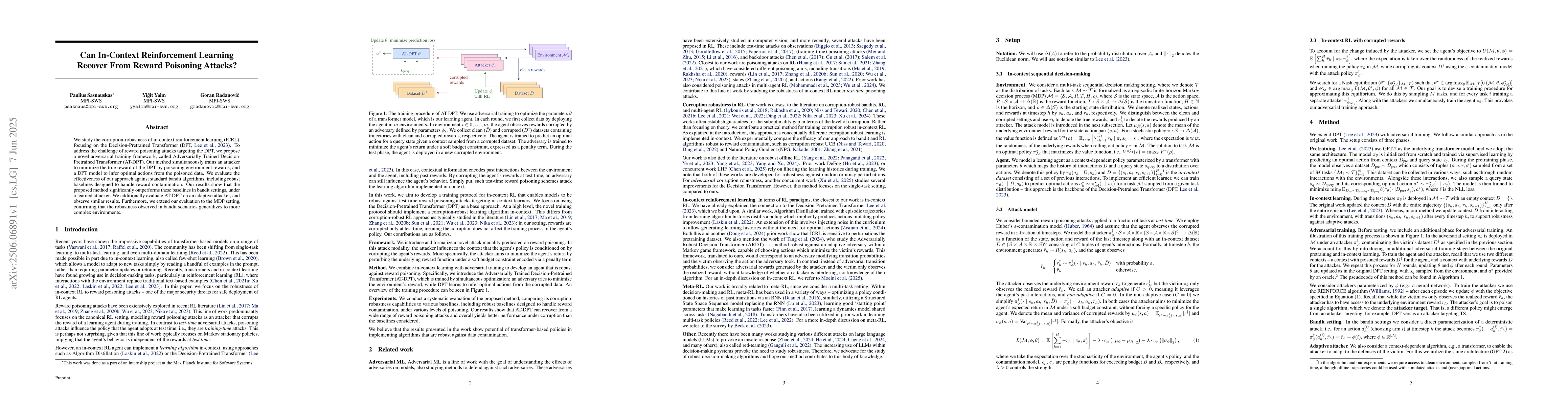
We study the corruption-robustness of in-context reinforcement learning (ICRL), focusing on the Decision-Pretrained Transformer (DPT, Lee et al., 2023). To address the challenge of reward poisoning attacks targeting the DPT, we propose a novel adversarial training framework, called Adversarially Trained Decision-Pretrained Transformer (AT-DPT). Our method simultaneously trains an attacker to minimize the true reward of the DPT by poisoning environment rewards, and a DPT model to infer optimal actions from the poisoned data. We evaluate the effectiveness of our approach against standard bandit algorithms, including robust baselines designed to handle reward contamination. Our results show that the proposed method significantly outperforms these baselines in bandit settings, under a learned attacker. We additionally evaluate AT-DPT on an adaptive attacker, and observe similar results. Furthermore, we extend our evaluation to the MDP setting, confirming that the robustness observed in bandit scenarios generalizes to more complex environments.
AI Key Findings
Get AI-generated insights about this paper's methodology, results, significance, and more — available when analysis has been generated.
Discussion 0