CAPE-JEPA - Cross-modal Adversarial Probabilistic Embedding JEPA
Abstract
Cross-modal remote sensing image retrieval (RS-CMIR) requires representations that are simultaneously modality-invariant and semantically discriminative, despite the profound physical gap between heterogeneous sensors such as Synthetic Aperture Radar (SAR) and multispectral imagery. Recent JEPA-based Predictive self-supervised approaches such as X-JEPA formulate cross-modal alignment as a deterministic latent forecasting task, implicitly assuming uniform patch predictability and leaving cross-modal distributional alignment unaddressed. We propose CAPE-JEPA, a probabilistic cross-modal Joint Embedding Predictive Architecture with three contributions: (i) a cross-attentional Gaussian predictor outputting per-patch parameters (mu, sigma^2) conditioned on opposite-modality context, trained via negative log-likelihood to model inherent cross-sensor prediction uncertainty; (ii) adversarial distributional regularization combining unimodal isotropic Gaussian regularization with a novel cross-modal adversarial variant that aligns modality distributions via worst-case Epps-Pulley characteristic function tests without explicit sample pairing; and (iii) in-training contrastive learning with attention-pooled heads for scene-level discriminative grounding. Evaluated on BigEarthNet-14K (BEN-14K) and fMoW across SAR, multispectral, and RGB modalities, CAPE-JEPA surpasses X-JEPA by up to 13.74 points on BEN-14K and 15.59 points on fMoW, outperforming all baselines including SkySense and CROMA across both unimodal and cross-modal directions while using fewer parameters (407.30M vs. 432.72M).
Analysis
AI-generated · verify against the original paper
Generated Jan 1, 0001ResultsWhat the authors found
- CAPE-JEPA outperforms X‑JEPA by up to 13.74 points on the BigEarthNet‑14K (BEN‑14K) benchmark.
- CAPE-JEPA surpasses X‑JEPA by up to 15.59 points on the fMoW dataset across SAR, multispectral, and RGB modalities.
- The model achieves higher retrieval performance than all baselines including SkySense and CROMA while using fewer parameters (407.30 M vs. 432.72 M).
LimitationsWhere the findings need caution
- The paper highlights deterministic prediction and geometrically disjoint modality distributions as limitations of prior X‑JEPA, but does not explicitly enumerate new limitations of CAPE‑JEPA in the provided excerpts.
MethodologyHow the work was done
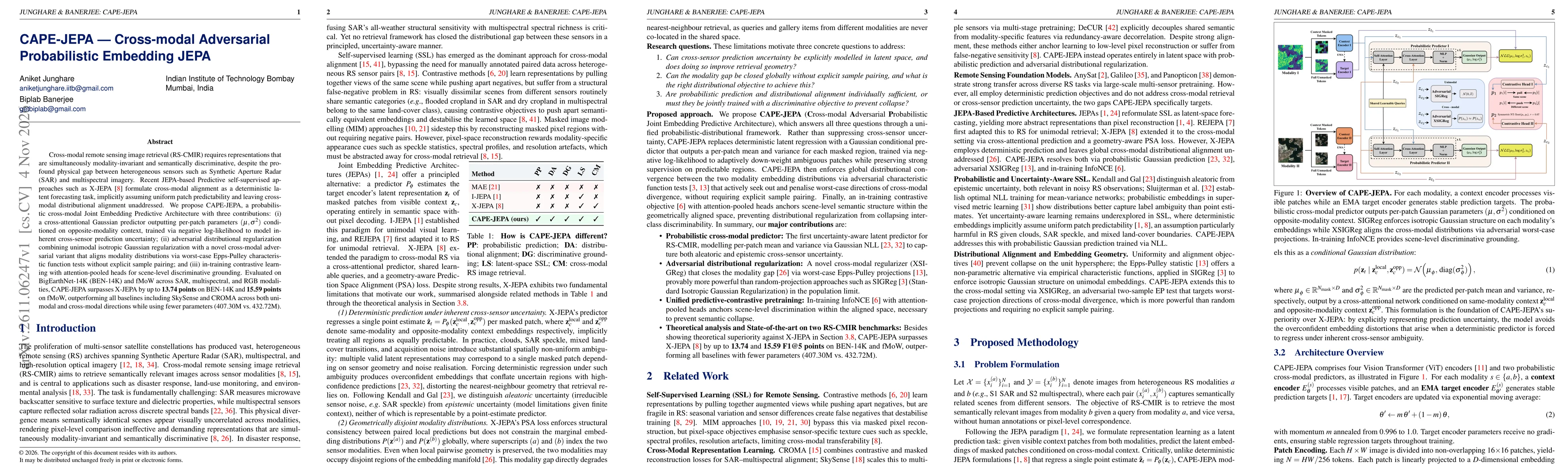
CAPE-JEPA introduces a probabilistic cross‑modal Joint Embedding Predictive Architecture that uses a cross‑attentional Gaussian predictor to output per‑patch mean and variance conditioned on opposite‑modality context, trains with negative log‑likelihood, applies adversarial distributional regularization combining isotropic Gaussian and a novel cross‑modal adversarial variant based on worst‑case Epps‑Pulley characteristic function tests, and incorporates in‑training contrastive learning with attention‑pooled heads for scene‑level discriminative grounding.
SignificanceWhy the work matters
The approach addresses the modality gap and inherent prediction uncertainty in cross‑modal remote sensing image retrieval, enabling more reliable and discriminative embeddings for heterogeneous sensor data, which is critical for applications such as disaster response and land‑use monitoring.
Technical contributionsWhat the work introduces
A three‑fold contribution: (i) a probabilistic Gaussian predictor modeling per‑patch uncertainty, (ii) an adversarial distributional regularization that aligns modality distributions without explicit pairing, and (iii) contrastive learning with attention‑pooled heads for scene‑level discrimination.
NoveltyHow it differs from prior work
Introducing a cross‑modal adversarial probabilistic embedding within a JEPA framework, combining uncertainty modeling with worst‑case characteristic function alignment, which has not been previously applied to remote sensing cross‑modal retrieval.
Discussion 0