Carnot Meets Quantum Information: Thermal Machine Driven by Probabilistic Non-orthogonal State Discrimination
The paper presents a two-reservoir quantum heat machine driven by probabilistic discrimination of non-orthogonal quantum states, exploring how state overlap (μ) and Carnot efficiency (ηC) shape its operation. It finds three distinct regimes (pure heat engine, mixed, and dissipative) with sharp thresholds, including a guaranteed positive work condition at high driving (ηC ≥ 0.5) and an unusual reentrant behavior at low driving, revealing deep links between quantum measurement limits and thermodynamic energy conversion.
Abstract
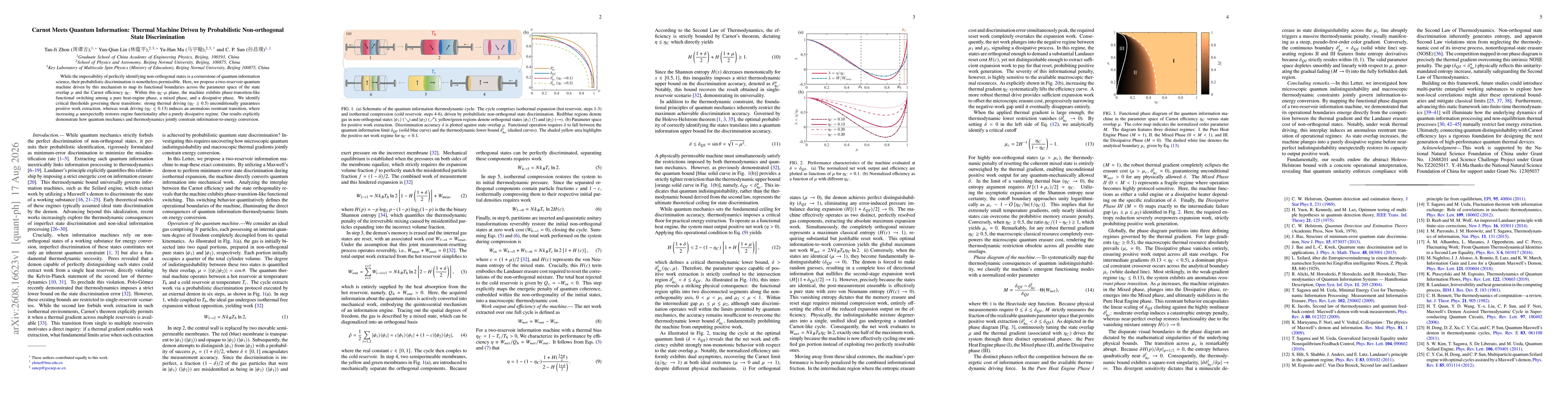
While the impossibility of perfectly identifying non-orthogonal states is a cornerstone of quantum information science, their probabilistic discrimination is nonetheless permissible. Here, we propose a two-reservoir quantum machine driven by this mechanism to map its functional boundaries across the parameter space of the state overlap $μ$ and the Carnot efficiency $η_C$. Within this $η_C$-$μ$ plane, the machine exhibits phase-transition-like functional switching among a pure heat-engine phase, a mixed phase, and a dissipative phase. We identify critical thresholds governing these transitions: strong thermal driving ($η_C \ge 0.5$) unconditionally guarantees positive work extraction, whereas weak driving ($η_C \lesssim 0.13$) induces an anomalous reentrant transition, where increasing $μ$ unexpectedly restores engine functionality after a purely dissipative regime. Our results explicitly demonstrate how quantum mechanics and thermodynamics jointly constrain information-to-energy conversion.
Analysis
AI-generated · verify against the original paper
Generated Aug 19, 2026ResultsWhat the authors found
- The engine exhibits phase-transition-like switching among a pure heat-engine phase, a mixed phase, and a dissipative phase in the η_C–μ parameter plane, with clear thresholds governing transitions.
- Strong thermal driving (η_C ≥ 0.5) guarantees positive work extraction regardless of state overlap μ, establishing a robust operational regime.
- Weak driving (η_C ≲ 0.13) produces an anomalous reentrant transition where increasing μ can restore engine functionality after a purely dissipative regime.
- The total cycle work W_out and efficiency η are given by analytic forms that couple the Landauer erasure cost via H(c) and the discrimination entropy, linking quantum indistinguishability to thermodynamic performance.
LimitationsWhere the findings need caution
- Analysis relies on an idealized two-reservoir setup with specific isothermal steps and perfect membrane discrimination models, which may not capture all real-world imperfections.
- The results are presented for fixed particle number and a particular discrimination protocol; finite-size fluctuations and other protocols could modify thresholds.
- Dynamic (finite-time) effects are not fully explored in detail, as the framework emphasizes steady, cycle-averaged quantities.
MethodologyHow the work was done
The study builds a two-reservoir quantum information engine that uses probabilistic discrimination of non-orthogonal states to drive isothermal expansion and information-to-energy conversion. It analyzes work output, heat exchange, and efficiency by deriving expressions for work steps, including discrimination success probability p_s = (1+δ)/2 and the resulting mixed-state entropy H(c) with c = (1+μ)/2, and maps performance in the η_C–μ plane to identify phase-like boundaries. The approach combines quantum state discrimination theory, Landauer erasure costs, and Carnot thermodynamics to obtain analytic relations such as W_out and η, and then characterizes phase transitions and reentrant behavior by varying η_C and μ.
SignificanceWhy the work matters
Demonstrates a direct, quantitative link between quantum state discrimination limits and macroscopic thermodynamic performance, providing a rigorous foundation for information-to-energy conversion in quantum thermal machines and clarifying how unitarity plus thermodynamics constrain such devices.
Technical contributionsWhat the work introduces
Provides an analytic mapping between quantum state discrimination limits (δ, μ) and thermodynamic costs (Landauer erasure) within a two-reservoir Carnot framework, yielding explicit expressions for W_out and η that reveal phase-transition-like boundaries and reentrant behavior.
NoveltyHow it differs from prior work
Introduces a two-reservoir quantum machine driven by probabilistic non-orthogonal state discrimination, uncovering phase-like transitions in operation, and identifies a universal bound structure where Carnot efficiency and overlap govern information-to-energy conversion.
Future workQuestions that remain
- Extend to multi-partite or entangled working substances to assess how nonlocal correlations affect operational boundaries.
- Investigate finite-time thermodynamics to understand the role of speed, nonadiabaticity, and dissipation in the η_C–μ phase diagram.
- Explore alternative measurement protocols and error models to evaluate robustness of the reentrant and threshold behaviors.
Discussion 0