Carry the Fine Print: Budget-Aware Visual Token Compression for Document OCR
Abstract
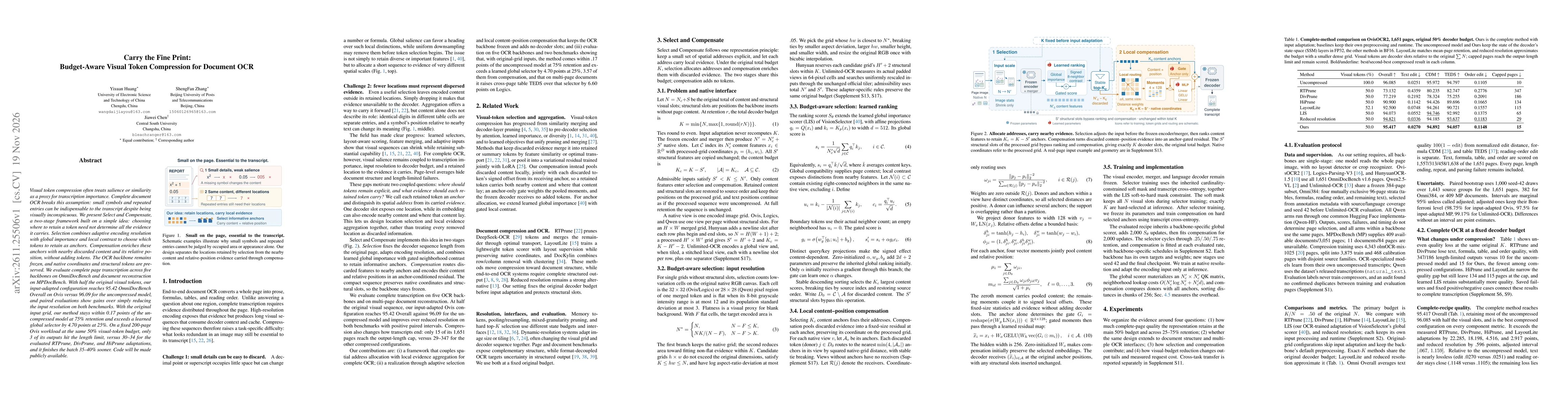
Visual token compression often treats salience or similarity as a proxy for transcription importance. Complete document OCR breaks this assumption: small symbols and repeated entries can be indispensable to the transcript despite being visually inconspicuous. We present Select and Compensate, a two-stage framework built on a simple idea: choosing where to retain a token need not determine all the evidence it carries. Selection combines adaptive encoding resolution with global importance and local contrast to choose which tokens to retain as anchors. Compensation enriches these anchors with nearby discarded content and its relative position, without adding tokens. The OCR backbone remains frozen, and native coordinates and structural tokens are preserved. We evaluate complete page transcription across five backbones on OmniDocBench and document reconstruction on MPDocBench. With half the original visual tokens, our input-adapted configuration reaches 95.42 OmniDocBench Overall on Ovis versus 96.09 for the uncompressed model, and paired evaluations show gains over simply reducing the input resolution on both benchmarks. With the original input grid, our method stays within 0.17 points of the uncompressed model at 75% retention and exceeds a learned global selector by 4.70 points at 25%. On a fixed 200-page Ovis workload at the same 50% visual-token budget, only 3 of its outputs hit the length limit, versus 30-34 for the evaluated RTPrune, DivPrune, and HiPrune adaptations, and it finishes the batch 35-40% sooner. Code will be made publicly available.
Analysis
AI-generated · verify against the original paper
Generated Jan 1, 0001ResultsWhat the authors found
- With half the original visual tokens, the input-adapted configuration reaches 95.42 OmniDocBench Overall on Ovis versus 96.09 for the uncompressed model.
- At 75% token retention the method stays within 0.17 points of the uncompressed model, and at 25% retention it exceeds a learned global selector by 4.70 points.
- On a fixed 200-page Ovis workload at a 50% visual-token budget, only 3 outputs hit the length limit versus 30–34 for RTPrune, DivPrune, and HiPrune.
- The same configuration finishes the batch 35–40% sooner than competing methods.
MethodologyHow the work was done
Select and Compensate is a two-stage framework where the Selection stage adaptively adjusts encoding resolution and combines learned global importance with gated local contrast to choose informative anchor tokens, and the Compensation stage enriches these anchors with nearby discarded content and its relative position without adding new tokens, keeping the OCR backbone frozen and preserving native coordinates and structural slots.
SignificanceWhy the work matters
The approach demonstrates that preserving small, visually inconspicuous symbols and repeated entries—crucial for complete document OCR—can be achieved with substantial token compression, enabling faster inference and reduced resource usage without major accuracy loss.
Technical contributionsWhat the work introduces
A novel coupling of spatial address allocation with local evidence aggregation that retains anchor locations while pooling discarded content and positional offsets, all without modifying the OCR backbone or adding decoder slots.
NoveltyHow it differs from prior work
Decoupling token selection from evidence retention via a compensation mechanism that enriches selected anchors with nearby content and relative position, allowing adaptive resolution and token budget control while preserving transcription-critical details.
Discussion 0